Choosing a new career is so nerve-wracking, isn’t it? There are so many factors one needs to consider before deciding to pursue a new career.
Are you looking for an exciting career after graduation or post-graduation in life science with a stable, recession-proof, and highly paid job?
If your answer is yes, then look no further. Having a career in medical coding might just be the right option for you.
Interested to know about Medical coding as a career? Read on to find out more.
What is medical coding?
Medical coding is the translation of various healthcare procedures, diagnoses, medical reports, equipment, and services into alphanumeric codes within the healthcare industry which helps to convert cumbersome medical reports into data-friendly codes. At present, It is one of the most essential aspects of healthcare.
Medical coding happens each and every time when you visit a doctor. Every time a patient consults a doctor for treatment, a record is kept which includes the symptoms of the patient, medical treatments and outcomes, patient’s medical history, diagnostic tests, and results which are further reviewed and coded by a medical coder.
Medical coder
What is the work of a medical coder?
Health information experts who are specialized in coding are called medical coders. They are the professionals responsible for translating the medical reports into medical codes and ensuring that the codes are used correctly in the medical billing process.
Medical coders review the medical record of a patient and translate it into alphanumeric and numeric codes. At first, coders abstract the critical details from a patient’s record and then evaluate various codes to assign them to represent the details.
What is to be learned in medical coding?
Medical Coding training syllabus majorly contains the following:
Human Anatomy
Medical terminology and definitions.
ICD-10-CM (International classification of diseases)
CPT (Current procedural Terminologies)
HCPCS (Healthcare common procedure coding system)
American Healthcare system and Insurance
Certifications
Although medical coding certifications are not a basic requirement to work as a medical coder, students with certifications are more preferable for employment. Certified medical coders also earn more than non-certified coders.
There are a number of certification courses a student can pursue but three of them i.e Certified Professional Coders (CPC), Certified Coding Specialists (CCS), and Certified Inpatient Coder (CIC) are the most common type of certification courses that are offered by different organizations.
Certified professional coders (CPC)
The certified professional coder (CPC) certification offered by the American Academy of Professional Coders (AAPC) is an ideal path for those who are interested in an outpatient setting.
Certified Coding Specialists (CCS)
The Certified Coding Specialist (CCS) certification offered by American Health Information Management Association (AHIMA) is an ideal path for those who are interested in inpatient activities.
Certified Medical Coder (CMC)
The CMC (Certified Medical Coder) certification is offered by Practice Management Institute (PMI).
The CMC certification is less common than CPC or CCS certification, but it has a more difficult examination pattern than the other two.
Why should you take medical coding as a career?
Coders are in demand
As healthcare is a basic human need, medical coders will always be in demand. During the pandemic, the number of visits to the hospital has increased a lot which required more specialists to understand, organize and bill correctly and code them.
The demand for medical coders has expanded a lot in the past few years. Job growth for medical coders is going to grow up to 18% within 2026 which shows a better future for coders in the healthcare industry.
Take less time to complete the course
Unlike the other courses which take a lot of time to complete, the certification course in medical coding can be completed in as little as four months or as long as a year. Medical coders can start doing jobs only after a few months or a year of training.
Can do online courses at your home
Many organizations are offering online courses for medical coding which is a good fit for the students.
Coders can work from home
Many organizations and hospitals are offering the option of working from home in a particular part of the time which provides flexibility to the workers.
Provides freelancing jobs
Freelancing gives the flexibility to choose when to work and when not to. This is the best option for coding specialists who don’t want to work under an employer. So medical coding provides flexibility to the coders to choose freelance projects.
Less course fees
Medical coding costs low fees as compared to the various medical schools. So it is financially affordable.
Flexible workplaces
Medical coders can work in various places like nursing homes, clinics, hospitals,
medical laboratories, and even in administrative support centers. So this course provides a lot of opportunities for employment.
Medical coding has upward mobility
Working with no chances of upward growth makes you unmotivated and frustrated in medical coding. There are chances of upward growth to become a healthcare administrator and various roles in management facilities.
High salary
Medical coding is one of the highly paid jobs. It was mentioned as one of the 14 top-paying allied health careers in the US. According to the AAPC’s annual salary survey, a medical coder earns $26.89 per hour and $55,923 per annum.
Career growth potential
The demand for medical coders has increased by 40% as compared to last year. So the medical coding field is growing at a faster rate. The employment of medical coders will increase by 15% within 2024. It shows better future employment for medical coders.
The salary and demand for coding specialists are expected to increase, with the introduction of new technology and increased data usage.
There is a better career opportunity with the highest paid salary in the field of medical coding. Many medical coding experts enjoy lifelong careers with medical coding credentials. With a diversity of experience and skills and multiple credentials, the career path options in medical coding are endless.
Medical Coder
Where do medical coders work?
The diversity of agencies, hospitals, and businesses opens a myriad career options to medical coders.
There are many workplace options for medical coders. Besides hospitals and health centers the medical coders can work in a physician’s office, ambulatory surgery centers, labs, physical therapy centers, sports medicine centers, home health agencies, consulting firms, medical equipment and supply vendors, accountable care organizations, insurance companies, billing companies, long term care facilities, and EHR software vendors.
Many medical coders also go to various colleges, universities, and training institutes to teach medical coding to the students.
You can also work as Subject Matter Experts(SME)s on a contractual basis if you want to become your own boss. An SME has various opportunities to work in short and long terms as bloggers, training specialists, trade journal contributors, curriculum contributors, partners with organizations of healthcare in various high schools, colleges, and institutions.
Many employers also hire remote medical coders who can work from home. AAPC’s annual medical salary survey shows that more than one-third of AAPC’s certified students work remotely under an employer.
Eligibility criteria for medical coding
Candidates aspiring to do a medical coding course must have passed a bachelor’s degree or a master’s degree, preferably in life science from an accredited institution.
So, if you are a diploma/graduate/post-graduate degree holder in the field of pharmacy, biochemistry, microbiology, biology, zoology, nursing then you are eligible to pursue this course.
Students from other streams can also become medical coders subject to proper training.
One must also have the analytical ability to analyze and read patients’ details and medical records using the right codes.
How to start your medical coding training?
After meeting the eligibility criteria, the aspiring candidate must find the best training institute to start the certification course. FluenceTech Academy is a pioneer in providing quality Medical Coding Training for those who are seeking to pursue a career in the medical coding industry.
After the completion of the medical training program, you may take CPC ( Certified Professional Coder) or CRC (Certified Risk Adjustment Coder) exams conducted by AAPC (American Academy of Professional Coder) and CCS ( Certified Coding Specialists) or CCA (Certified Coding Associate) conducted by AHIMA (American Health Information Management Association) for better growth potential.
When you are certified, it improves your chances of better pay and better opportunities. The medical coding certifications are global credentials and are beneficial for various roles within the healthcare industry such as medical coding, auditing, billing, practice management, and compliance.
Conclusion
Medical coding is a fast-paced industry in today’s era. It plays an important key role in the modern healthcare system. It is also used by different organizations for effective communication with other healthcare systems throughout the world.
According to the Bureau of Labour Statistics (BLS), the demand for medical coding experts will rise up to 8% from 2019 to 2029 which is more than average. It shows a lot of new job openings for medical coding experts in both national and international fields.
There will be exponential demand for trained medical coders globally going into 2022. So there cannot be a better time to start your career in medical coding than now.
You can get yourself trained in medical coding from the comfort of your home as FluenceTech Academy provides online Medical Coding training.
Are you curious about what the future holds for medical coding? As we dive deeper into the technological age, the healthcare industry is no exception to technological advancements.
The future of medical coding looks incredibly promising with new trends and predictions emerging every day.
Are you ready to explore the possibilities and future of the medical coding world in 2023 and beyond?
Let’s take a closer look at the exciting developments on the horizon.
What is medical coding?
Medical coding is the process of converting medical diagnoses, procedures, and services into alphanumeric codes. These codes are used for medical billing, insurance claims, and for tracking patient care and outcomes. Medical coding is essential for the healthcare industry as it helps in efficient reimbursement for medical services rendered to patients.
There are three types of medical coding: ICD codes, CPT codes, and HCPCS codes. ICD codes (International Classification of Diseases) are used to classify diseases and medical conditions. CPT codes (Current Procedural Terminology) are used to describe medical procedures and services. HCPCS codes (Healthcare Common Procedure Coding System) are used for medical equipment, supplies, and other services not covered by CPT codes.
Medical coders are responsible for assigning codes to medical procedures and diagnoses, ensuring that they are accurate and up-to-date. They work closely with healthcare providers to ensure that all necessary information is captured and properly coded. Medical coding is a highly specialized field that requires extensive knowledge of medical terminology, anatomy, and physiology.
The demand for medical coders has increased in recent years, with the healthcare industry expanding and becoming more complex. Medical coding is also a highly sought-after career due to its stability and high earning potential. However, it requires significant training and certification, and continuing education is necessary to stay up-to-date with changing codes and regulations.
Importance of medical coding
Medical coding is essential in the healthcare industry for a variety of reasons. Firstly, it allows for efficient and accurate billing and reimbursement for medical services provided to patients. Without medical coding, it would be difficult to track the services rendered and to ensure that healthcare providers are reimbursed appropriately.
Secondly, medical coding plays a vital role in healthcare data analysis and research. The codes used in medical coding provide a standardized language for healthcare providers and researchers to communicate and track patient care and outcomes. This data is used to identify trends in patient health, track the efficacy of treatments, and develop new medical technologies and procedures.
Finally, medical coding is also important for compliance with regulatory requirements. Government agencies and insurance companies require that medical procedures and diagnoses are properly coded to ensure that healthcare providers are following regulations and providing the highest quality of care to patients.
Overall, medical coding is crucial for the smooth operation of the healthcare industry and for ensuring that patients receive the best care possible.
A brief history of medical coding
Medical coding is the process of assigning codes to medical diagnoses, procedures, and treatments for billing and insurance purposes. The history of medical coding can be traced back to the 17th century when John Graunt used numerical analysis to study mortality rates in London. However, it wasn’t until the mid-20th century that medical coding began to be widely adopted.
In the 1960s, the American Medical Association (AMA) developed the Current Procedural Terminology (CPT) code set, which was used to describe medical procedures and services. In the 1970s, the International Classification of Diseases (ICD) was adopted as the standard for coding diagnoses and diseases.
As medical coding became more complex, in the 1990s, the Healthcare Common Procedure Coding System (HCPCS) was introduced to provide additional codes for medical services not covered by CPT or ICD codes.
In recent years, there has been a shift towards electronic medical records (EMRs) and the use of standardized code sets such as SNOMED CT (Systematized Nomenclature of Medicine – Clinical Terms) and ICD-10-CM (Clinical Modification). These codes allow for more accurate and efficient communication of medical information between healthcare providers, insurers, and government agencies.
Current State of Medical Coding
Overview of the current coding systems
There are several medical coding systems currently in use, each serving a different purpose in the healthcare industry. The two primary coding systems used for clinical diagnoses and procedures are the International Classification of Diseases (ICD) and the Current Procedural Terminology (CPT) code sets.
ICD codes are used to classify and code medical diagnoses and procedures. The current version of ICD, ICD-10, has more than 70,000 codes and is used by healthcare providers and insurance companies to document and bill for medical services.
CPT codes, on the other hand, are used to describe medical services and procedures performed by healthcare providers. CPT codes are developed and maintained by the American Medical Association (AMA) and are used by healthcare providers and insurance companies to bill for services rendered.
There are also additional coding systems used for specific purposes within the healthcare industry, such as the Healthcare Common Procedure Coding System (HCPCS) used for Medicare billing and reimbursement, and the National Drug Code (NDC) used for identifying and billing for medications.
Accurate and consistent medical coding is essential for ensuring proper reimbursement for medical services, tracking disease trends and outcomes, and providing valuable data for research and public health initiatives.
Challenges with current coding systems
Despite their importance, the current medical coding systems face several challenges that can impact their effectiveness and efficiency. One challenge is the sheer volume of codes and frequent updates to the coding systems. This can lead to confusion and errors, as well as the need for ongoing training and education for healthcare providers and coding professionals.
Another challenge is the potential for coding errors, either due to human error or lack of specificity in the code set. This can result in inaccurate billing, denied claims, and even legal or financial penalties for healthcare providers.
There is also a lack of standardization across different coding systems, which can make it difficult to compare data across different healthcare organizations and regions. This can impede efforts to track disease trends, evaluate healthcare outcomes, and identify areas for improvement.
Finally, the cost of implementing and maintaining medical coding systems can be a significant burden for healthcare organizations, particularly smaller providers who may not have the resources to invest in the necessary technology and training.
Addressing these challenges will require ongoing collaboration and innovation from healthcare providers, coding professionals, and policymakers. This may include efforts to simplify and streamline coding systems, increase standardization, and improve education and training for those involved in the coding process.
Impact of technological advancements on medical coding
Technological advancements have greatly impacted medical coding in the current state. With the increasing use of electronic health records and artificial intelligence, medical coders can more accurately and efficiently assign codes to diagnoses and procedures. These technologies have also improved communication between healthcare providers and insurance companies, reducing errors and speeding up the billing process. However, the use of technology has also created new challenges, such as the need for ongoing training to keep up with updates and changes in coding systems. Overall, technological advancements have greatly improved the efficiency and accuracy of medical coding, leading to better patient care and reimbursement for healthcare providers.
Trends in Medical Coding for 2023 and Beyond
Medical coding is a vital aspect of healthcare administration and reimbursement. It involves the translation of medical diagnoses, treatments, procedures, and services into alphanumeric codes that are recognized by insurance companies and other third-party payers. Medical coding provides an accurate and standardized way to communicate medical information, which helps to ensure that healthcare providers receive proper reimbursement for their services.
As we look to the future of medical coding, several trends are emerging in the field of medical coding that are likely to shape the way healthcare providers and payers manage their operations. Here are some of the key trends in medical coding for 2023 and beyond:
Increased use of artificial intelligence (AI)
AI is expected to play an increasingly important role in medical coding, particularly with the use of natural language processing (NLP) technology. NLP can help to automate the coding process by extracting relevant information from clinical documentation and mapping it to appropriate codes. This can save time and reduce errors, improving the accuracy and efficiency of medical coding.
Greater emphasis on data analytics
Healthcare providers and payers are collecting more data than ever before, and medical coding is a critical source of this data. As such, there will be a greater emphasis on using data analytics to gain insights into healthcare utilization, outcomes, and costs. This will require medical coders to have a deeper understanding of how their codes are used and how they impact healthcare decision-making.
Evolving code sets
Medical coding systems are constantly evolving to keep pace with changes in healthcare practices and technology. For example, the ICD-11 (International Classification of Diseases, Eleventh Revision) was released in 2018 and includes significant updates to the previous version. As healthcare continues to evolve, medical coding systems will likely continue to adapt to meet new challenges and requirements.
Increased focus on quality and compliance
Healthcare providers and payers are under increasing pressure to ensure that their coding practices are compliant with regulatory requirements and best practices. This means that medical coders will need to be highly skilled and knowledgeable, with a keen eye for detail and a commitment to accuracy.
Greater collaboration between healthcare stakeholders
Medical coding is a critical link between healthcare providers, payers, and patients. As such, there is a growing recognition of the need for greater collaboration and communication between these stakeholders to improve healthcare outcomes and reduce costs. This will require medical coders to be effective communicators and collaborators, able to work closely with other healthcare professionals to achieve common goals.
Predictions for the Future of Medical Coding
Medical coding is a complex and essential part of the healthcare system. It involves the translation of medical diagnoses, procedures, and services into standardized codes that are used for billing and reimbursement purposes. Over the years, medical coding has undergone significant changes, and it is expected to continue evolving in the near future of medical coding. In this article, we will explore some predictions for the future of medical coding.
Increased Use of Artificial Intelligence (AI)
Artificial intelligence is likely to play an increasingly important role in medical coding. Machine learning algorithms can be trained to identify patterns in medical data, which can be used to automate the coding process. This can save time and improve the accuracy of medical coding. As AI technology continues to develop, it is expected that it will be able to analyze unstructured data such as medical notes and transcriptions, further streamlining the coding process.
Expansion of Coding Standards
With the increasing complexity of medical procedures and services, there is a growing need for more detailed and nuanced coding standards. It is expected that coding standards will continue to expand to accommodate these changes. For example, new codes may be introduced to reflect emerging medical technologies, such as gene therapy or personalized medicine.
Greater Emphasis on Data Analytics
Healthcare providers and payers are collecting more data than ever before. Medical coding is a critical source of this data, and it is expected that there will be a greater emphasis on using data analytics to gain insights into healthcare utilization, outcomes, and costs. Medical coders will need to have a deep understanding of how their codes are used and how they impact healthcare decision-making.
Integration with Electronic Health Records (EHRs)
Electronic health records (EHRs) are becoming increasingly prevalent in the healthcare system. EHRs are digital records that contain a patient’s medical history, diagnoses, medications, and other relevant information. It is expected that medical coding will become more integrated with EHRs, allowing for a seamless transfer of information between medical coders and healthcare providers. This integration will improve the accuracy of medical coding, reduce errors, and streamline the reimbursement process.
Increased Focus on Quality and Compliance
There is an increasing emphasis on ensuring that medical coding practices are compliant with regulatory requirements and best practices. Healthcare providers and payers are under pressure to demonstrate that their coding practices are accurate, transparent, and reliable. Medical coders will need to be highly skilled and knowledgeable, with a keen eye for detail and a commitment to accuracy. This will require ongoing training and professional development to stay up-to-date with changing regulations and best practices.
Conclusion
In conclusion, the future of medical coding is bright and promising. With the increasing use of AI, expansion of coding standards, greater emphasis on data analytics, integration with EHRs, and increased focus on quality and compliance, medical coding is set to become more accurate, efficient, and reliable.
These developments will have significant implications for healthcare providers, payers, and patients, improving the quality of care, reducing errors, and ensuring that providers are reimbursed accurately for their services.
As the healthcare landscape continues to evolve, medical coding will play an increasingly critical role, facilitating better decision-making, driving innovation, and improving patient outcomes. The future of medical coding is not only exciting but also essential to the continued advancement of the healthcare industry.
As we step into the new year, it is essential for businesses to stay up-to-date with the latest trends in digital marketing. With technology evolving at a rapid pace, the marketing landscape is continually changing, making it essential for companies to adapt their marketing strategies to remain competitive.
Let’s dive into the article below to findout the top digital marketing trends for 2023.
What is digital marketing?
Digital marketing refers to the use of digital technologies, such as the internet, social media, mobile devices, search engines, email, and other digital channels to promote a brand, product, or service. It is an umbrella term that covers a wide range of activities, strategies, and tactics aimed at increasing brand awareness, driving traffic, generating leads, and ultimately, converting leads into customers.
Digital marketing can include a variety of tactics, such as search engine optimization (SEO), pay-per-click advertising (PPC), social media marketing, email marketing, content marketing, affiliate marketing, and influencer marketing, among others.
The main advantage of digital marketing is its ability to target specific audiences with precision, which allows businesses to reach the right people at the right time with the right message. It also provides a wealth of data and analytics that can be used to optimize campaigns, measure results, and improve overall marketing effectiveness.
Overall, digital marketing has become an essential component of most modern marketing strategies, as more and more people spend increasing amounts of time online, and businesses seek to capitalize on the opportunities presented by digital channels to reach and engage with their target audiences.
Importance of keeping up with digital marketing trends
Keeping up with digital marketing trends is crucial for businesses and marketers who want to stay competitive and effective in their marketing efforts. Here are some of the reasons why:
Changes in consumer behavior
As technology advances and new platforms emerge, consumer behavior changes accordingly. Keeping up with the latest digital marketing trends can help businesses understand how their target audience is using digital channels and adapt their marketing strategies accordingly.
Increased competition
With the rise of digital marketing, competition has increased significantly. Staying up to date with the latest trends can help businesses stay ahead of the competition and differentiate themselves in a crowded market.
Evolving algorithms
Search engine and social media algorithms are constantly changing, and staying up to date with these changes is essential for businesses that want to ensure their content is visible to their target audience.
Cost-effectiveness
Digital marketing can be a cost-effective way to reach a large audience, but staying up to date with the latest trends is important to ensure that marketing efforts are efficient and effective.
Better targeting and personalization
As digital marketing continues to evolve, new tools and techniques are emerging that allow businesses to target and personalize their marketing efforts with increasing precision. Staying up to date with these trends can help businesses improve their targeting and engagement with their audience.
Overall, keeping up with digital marketing trends is essential for businesses that want to stay relevant and effective in their marketing efforts. It allows them to take advantage of new opportunities, adapt to changing consumer behavior, and stay ahead of the competition.
A brief overview of the top digital marketing trends for 2023
Voice Search Optimization
Voice search optimization is a digital marketing trend that has gained significant importance in recent years, as more and more people are using voice assistants and smart speakers to search for information and make purchases. Voice search optimization involves optimizing digital content, such as websites and blogs, to improve its visibility and ranking in voice search results.
One of the main reasons why voice search optimization has become a critical trend in digital marketing is the growing popularity of voice assistants and smart speakers. According to research, 55% of households in the United States are expected to have a smart speaker by 2022. As a result, optimizing digital content for voice search is essential for businesses that want to reach their target audience through this emerging channel.
Voice search optimization involves several tactics, including using long-tail keywords that match the way people speak, creating content that answers common questions, optimizing for local search, and improving website speed and mobile responsiveness.
By optimizing their digital content for voice search, businesses can improve their visibility and reach in search engine results pages, and ultimately drive more traffic and conversions. Voice search optimization is becoming an increasingly important trend in digital marketing, and businesses that don’t adapt to this new channel risk being left behind.
Artificial Intelligence and Machine Learning
Artificial intelligence (AI) and machine learning (ML) are two digital marketing trends that are transforming the way businesses approach marketing. AI and ML technologies use data and algorithms to automate and optimize marketing processes, enabling businesses to make more informed decisions and drive better results.
Here are some of the ways AI and ML are being used in digital marketing:
Personalization
AI and ML can analyze large amounts of data to identify patterns and personalize marketing messages based on individual preferences, behavior, and demographic information.
Predictive analytics
By analyzing historical data, AI and ML can predict future outcomes and help businesses make better decisions, such as which products to promote or which channels to invest in.
Chatbots and virtual assistants
AI-powered chatbots and virtual assistants can provide customer service and support around the clock, improving customer engagement and satisfaction.
Ad optimization
AI and ML can analyze ad performance data in real-time and optimize ad campaigns to improve conversion rates and reduce costs.
Content creation
AI and ML can generate personalized and relevant content based on data, such as social media posts, emails, and even blog articles.
Overall, AI and ML are becoming increasingly important in digital marketing, as they can help businesses make smarter decisions, automate repetitive tasks, and improve the customer experience. By leveraging these technologies, businesses can stay ahead of the competition and achieve better marketing results.
Video Marketing
Video marketing is a digital marketing trend that has gained significant popularity in recent years, as more and more people consume video content on social media and other digital platforms. Video marketing involves creating and sharing videos to promote a brand, product, or service, and is an effective way to engage with audiences and drive conversions.
Here are some of the reasons why video marketing has become an essential trend in digital marketing:
Increased engagement
Video content is more engaging than other forms of content, such as text or images, as it can convey emotion, personality, and storytelling. This leads to higher engagement rates and better audience retention.
Improved brand awareness
Video content can help businesses build brand awareness and establish a brand voice by showcasing their products, services, and values in a compelling way.
Higher conversion rates
Video content can be used to educate and inform audiences about products and services, which can lead to higher conversion rates and sales.
Increased shareability
Video content is highly shareable on social media and other digital platforms, which can increase brand exposure and reach.
Diverse formats
Video content can be produced in a variety of formats, including explainer videos, product demos, live streams, webinars, and social media stories, providing businesses with multiple options for engaging with their target audience.
Overall, video marketing has become an essential digital marketing trend, as it provides businesses with a powerful tool to engage with audiences, increase brand awareness, drive conversions, and improve overall marketing performance.
Social Media Stories
Social media stories are a digital marketing trend that has gained significant traction in recent years, as they provide businesses with a new way to engage with audiences and drive brand awareness. Social media stories are short-form, vertical videos or images that disappear after 24 hours, and are typically shared on platforms like Instagram, Facebook, and Snapchat.
Here are some of the reasons why social media stories have become an essential trend in digital marketing:
Increased engagement
Social media stories are highly engaging, as they provide businesses with a new way to connect with audiences in a more personal and authentic way.
Improved brand awareness
Social media stories can be used to showcase products, services, and behind-the-scenes content, which can help businesses build brand awareness and establish a brand voice.
Increased reach
Social media stories can be discovered through hashtags and location tags, and can also be shared on other social media channels, providing businesses with an opportunity to reach new audiences.
Diverse formats
Social media stories can be produced in a variety of formats, including photos, videos, and boomerangs, providing businesses with multiple options for creating engaging content.
Real-time marketing
Social media stories can be used to share real-time updates, promotions, and events, providing businesses with a new way to engage with audiences in the moment.
Overall, social media stories have become an essential digital marketing trend, as they provide businesses with a powerful tool to engage with audiences, increase brand awareness, and improve overall marketing performance. By leveraging social media stories, businesses can stay ahead of the competition and achieve better marketing results.
Interactive Content
Interactive content is a digital marketing strategy that has become increasingly popular in recent years, as it provides businesses with a new way to engage with audiences and drive conversions. Interactive content is content that requires the audience to actively participate, such as quizzes, polls, assessments, and interactive videos.
Here are some of the reasons why interactive content has become an essential digital marketing strategy:
Increased engagement
Interactive content is highly engaging, as it provides audiences with a new way to connect with a brand and actively participate in the content.
Improved brand awareness
Interactive content can be used to educate and inform audiences about a brand’s products and services, which can help businesses build brand awareness and establish a brand voice.
Higher conversion rates
Interactive content can be used to collect data on audience preferences, behavior, and demographics, which can lead to higher conversion rates and sales.
Increased shareability
Interactive content is highly shareable on social media and other digital platforms, which can increase brand exposure and reach.
Diverse formats
Interactive content can be produced in a variety of formats, including quizzes, polls, assessments, and interactive videos, providing businesses with multiple options for engaging with their target audience.
Overall, interactive content has become an essential digital marketing strategy, as it provides businesses with a powerful tool to engage with audiences, increase brand awareness, drive conversions, and improve overall marketing performance. By leveraging interactive content, businesses can stay ahead of the competition and achieve better marketing results.
Conclusion
Staying up-to-date with the latest digital marketing trends is critical to the success of any business. By leveraging the latest technologies and trends, businesses can improve their efficiency, enhance customer experiences, and drive sales.
So, if you want to stay ahead of the competition in 2023, start implementing these digital marketing trends in your marketing strategy today.
Are you wondering which digital marketing skills to learn?
In this data-driven society, the digital domain is constantly evolving. So various businesses are constantly moving towards digital along with traditional marketing to have an online presence.
So undoubtedly, the demand for digital marketing specialists is skyrocketing. So learning the in-demand digital marketing skills can go a long way in shaping up one’s career for the better.
In this article, we have listed the 7 highest paid digital marketing skills that can help you land a lucrative career.
High paying digital marketing skills
Sarch Engline Optimization (SEO)
A Search Engine Optimization (SEO) specialist is a professional who optimizes the website for a search engine by analyzing, reviewing, and implementing changes to it.
The primary purpose of an SEO specialist Is to ensure on-page optimization to increase traffic to the website and to provide a positive user experience.
An SEO specialist increases the traffic to his website by leveraging SEO tools and conducting keyword research.
SEO is an integral part of digital marketing and helps to get the best Return on Investment (ROI). So businesses are now investing more in SEO and SEM and skilled SEO professionals are in demand.
Entry-level SEO roles pay anywhere between 2-3 lakh per annum in India and with experience, one can earn more.
Remote job opportunities from USA/UK can pay anything upward of $3000 per month. There are many lucrative freelancing opportunities available as well.
Paid Ads
Though a lot of businesses prefer to grow and reach out to targeted audiences organically, it takes time to achieve significant results. So paid ads play an important role in reaching out to the targeted audience in the shortest possible time.
Paid ads can be Google Ads, Facebook Ads, Native ads, etc.
Running Paid Ad campaigns needed a specific skill set and learning the nuances of running successful paid ad campaigns can open up a lot of opportunities.
As more and more businesses are going online and the e-commerce space is growing in leaps and bounds, the demand for paid ads specialists is on the rise.
Paid Ads specialist can start with a salary of 3-4 lakh per year and with more experience and results under her belt, she can earn more. Remote and freelancing opportunities are even more lucrative.
Social media marketing
Around 3.78 billion people hang out on various social media every day. That’s a huge number. Marketers and businesses all over the world are trying to reach out to them through social media marketing.
So, social media marketers are in demand.
The major role of a social media marketer is to determine the social media platform to use for brand awareness, to identify the target market, to increase the followers, to engage the followers with the brand, formulate strategies to improve revenue from social media efforts.
As the role provides creative freedom, work from anywhere, and freelancing opportunities, it is one of the most glamorous jobs among youngsters.
The average salary of a social media marketer starts around 3-4 lakh per annum.
Content Marketing
Content marketing is about planning, creating, publishing, and distributing quality content for a targeted audience and converting them into customers.
A content marketer plays an important role as a mediator between the interest of a specific audience and the business.
Content is the core of any business. A business can’t succeed without valuable content. So a content marketer plays a very important role in the growth of any business.
A content marketer must have the basic knowledge of communication, storytelling, research, and digital marketing to be proven as a valuable asset for the company.
The salary of a content marketer varies as per the experience. The average salary of a content marketer can be around 5-6 lakh per annum.
Content Writing and Copywriting
Creating valuable content and writing a copy that makes people take action is an amazing skill to have. Copywriting is one of the highest-paid skills in the world.
Every business needs customers and revenue to survive and flourish. Compelling content and well-written copy help people come into the sales funnel of any business and ultimately turn into paying customers.
Mastering content writing and copywriting skills can put your career on the fast track.
There are many jobs as well as high-paying freelancing opportunities available.
Email marketing
Email marketing provides the best ROI among all marketing channels.
For every $1 you spend on email marketing, the ROI is $42.
Learning and mastering Email marketing skills can open doors to tons of opportunities for you to explore.
The role of an email marketing specialist revolves around email list building, planning and strategizing email marketing campaigns, tracking the campaign metrics like open rate, click-through rate, etc.
As more and more businesses are looking for email marketing specialists, the demand is on the rise.
An average email marketing specialist earns around 3-4 lakh per annum. One or two other digital marketing skills along with Email marketing can give your career a new high.
Video editing
People love to watch videos. Video content is getting more traction across various platforms. As more and more video content is produced, the demand for skilled video editors is on the rise.
As a video editor, you can work independently for a number of clients or take up a video editing job in a digital marketing or media company.
Skills to edit videos using popular video editing applications like Filmora, Adobe premiere pro are in high demand.
A skilled video editor can make more than 6-7 lakh per month.
Final Words
If you have read so far, you must have understood how lucrative is it to learn these digital marketing skills.
Mastering any of these skills can make you part of the ever-growing digital revolution and will give your career the boost it needs to succeed.
You can learn these high-paying digital marketing skillsfrom FluenceTech Academy – where real-life digital marketing professionals will mentor you and will handhold you to the world of Digital Marketing.
Talk to our course counselor for details about learning high-paying digital marketing skills.
Are you wondering why should you learn Social Media Marketing? Is there any framework or course to learn social media marketing? Does it even worth your time learning the nuances of Social media?
If you are seeking answers to these questions, you are at the right place.
More and more people are spending their time, meeting friends, doing shopping, and hanging out on various social media platforms than ever.
People are making their purchasing decision based on social media reviews of other buyers.
So more and more businesses are trying to reach out to their potential customers through these social media channels.
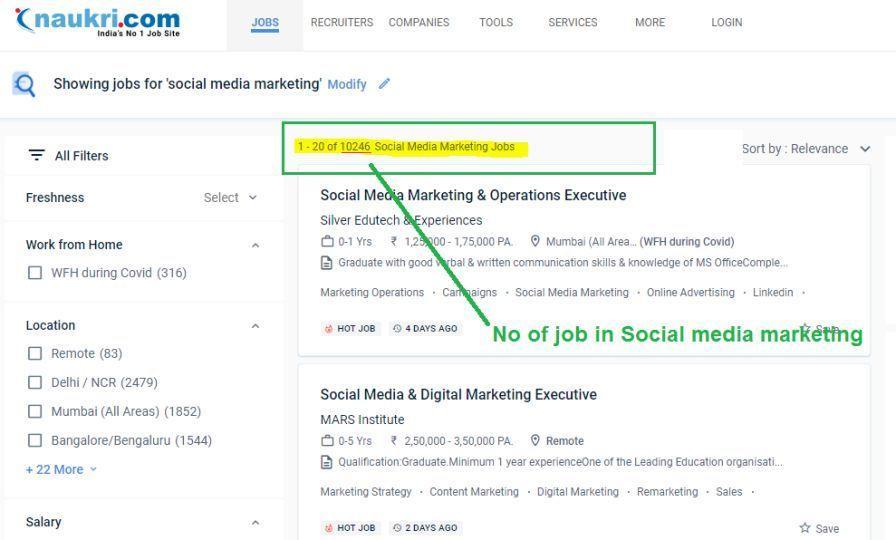
So the demand for skilled social media marketers is on the rise and companies are making a beeline for hiring talented social media marketers.
Do not believe us? Then you should see the following
Pic Credit: Naukri.com
Now that you know companies are looking for social media marketers, it is time to know how you can become one.
Read this article to get all your questions answered. Here you go.
What is social media marketing?
Social media marketing refers to the usage of various social media channels to promote the product or service of your company.
It is an essential strategy to reach a lot of customers with little effort and a very popular domain among researchers and practitioners.
This marketing strategy generally involves publishing great content on your social media profiles, engaging your followers with the content, listening to their problems, analyzing the results, and running social media advertisements.
It is an effective way to stay engaged with the existing customers and to connect with the new customers simultaneously.
Today’s generation has become the generation of social media. It has become the biggest platform for public interaction. Every person, even a small child, is now using social media channels in a myriad of different ways.
Nearly one-third of the total population is now using any type of social media platform. So social media marketing is an effective strategy to build connections.
That’s why 97% of total global share companies are using social media marketing. So undoubtedly, it has become a valuable skill set in digital marketing.
With new platforms and features being introduced every day, social media marketing is constantly evolving. So this is one of the important skill sets to be learned not only to increase your business but also to be proven as a valuable asset to the company.
What do social media marketers do?
Social media marketers are the professionals who generally use different social media platforms to promote a company’s product or service.
Besides these, a social media marketer oversees the overall social media strategy of an organization, monitors social media metrics for future performance optimization, stays engaged with the customers and solves all their queries, and stays up-to-date with social media trends, laws, technologies, and best practices.
They play a very important role to increase brand awareness and traffic to the website. So they are the essential factors for a company.
Why should you learn social media marketing?
Social Media Marketers are in Demand
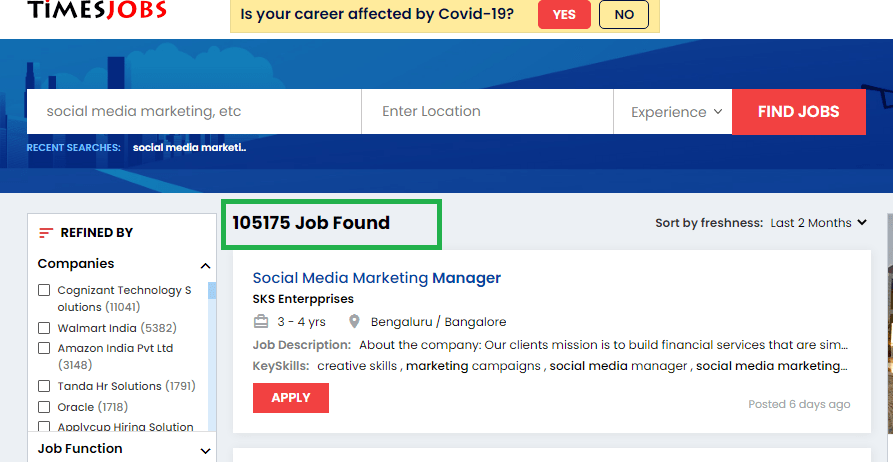
As most companies are using various social media channels to connect with their potential customers, the demand for social media marketers is on the rise.
If you scroll through any job site, you will find hundreds of lucrative job offerings for social media marketers.
Pic Credit: Timesjobs
So if you acquire the required skills set to manage various social media platforms, you will be a valuable asset for any company and your skills will always be in demand.
Build your personal brand and business
Creating and sharing valuable content on various social media channels makes you an online persona and reflects your skills and values.
The right kind of techniques and knowledge of content creation on different social media can go a long way in shaping up your online presence, audience engagement, and building your personal brand as well as that of your business.
Eventually, your content creation, sharing, and reaction to any feed become a public narrative.
Get freelancing opportunity
Freelancing gigs are the buzzword these days. A lot of businesses as well as individuals are dependent on skilled freelancers to get their job done.
If done effectively, social media marketing can be one of the driving forces to grab a freelancing opportunity.
Upskilling yourself with social media tactics and building a personal brand helps you to get a lot of opportunities and opens up multiple sources of income for you.
An interesting subject to learn
Unlike other subjects, Social media marketing is an interesting subject to learn which creates interest within you to study.
A survey by AMA shows that most of the management students find their classes boring and they check up their social media accounts multiple times.
On the other hand, students learning social media are found to be more awake and active in the class and take interest in the topic.
So not only studying SMM will be enjoyable but it will be like living out of something you are obsessed with just as tasting different kinds of chocolate every day and getting paid for it.
So undoubtedly, SMM is an interesting course to study.
Get global exposure
Social media is a platform where you can get connected to anyone from any part of the world without any barrier whatsoever.
This provides you the opportunity to network with different people, know their culture and it helps in your personal growth as well.
In traditional marketing where we are confined to limited space, social media marketing gives you global exposure.
You can learn new things, get different perspectives, improve as a professional and as a person.
A cost-effective way to reach a larger audience
Social media marketing is one of the most cost-effective ways to reach out to potential customers. You can start a business right from your phone after creating an account without having to pay a single penny.
Being cost-effective, it helps you to get a high Return on Investment ( ROI) so that the budget can be utilized for other aspects of running a business.
Social media platforms are huge platforms with billions of users. The number of users of these platforms is also increasing day by day.
So with more quality content, you can get more inbound traffic making greater conversion opportunities.
Besides this, by using ads on various social media platforms, you can reach out to the targeted audiences for faster conversion and more revenue.
This is super beneficial for any business as it allows them to market their products or services to an audience that is more likely to convert.
Major Social Media Platforms
Facebook
Facebook reported about 1.93 billion daily active users and about 2.89 billion monthly active users. This makes Facebook one of the go-to platforms for any marketer.
Learning how to run Facebook ads effectively to reach out to this huge demographic and generate revenue for any business can make you the most sought-after professional.
Instagram
Instagram is one of the most popular social media platforms out there and ranks second behind Facebook in terms of active social media users with daily active users of more than 500 million.
This popular app allows businesses and individuals to create profiles and connect to fellow users instantly.
This application is a great tool to promote the business while being creative simultaneously.
Pinterest
Pinterest is a popular visual social media platform where a user can create and share pins, shops, and boards.
Using Pinterest for your business can benefit you to increase brand exposure and widen your potential customer base.
Pinterest makes it easier to connect the audience with your content and ensures your blog post is read by more users.
LinkedIn
LinkedIn is a professional network and the platform helps the individual connect with the potential recruiters if they are seeking jobs and vice versa.
LinkedIn is also a great platform for businesses to generate potential leads and reach out to targeted clients.
Learning tactics and implementing growth hacks to optimize your LinkedIn profile can go a long way in helping you establish a skillful social media marketer.
Twitter
Twitter is undoubtedly a powerful platform to increase the reach of the business. Twitter is a place where you meet your potential customers and interact with them directly.
You can also build a strong personal brand on Twitter by sharing consistent valuable content on the platform.
Learning Twitter growth hacks can immensely help you build your personal brand as well as the brand equity of your business.
Career growth potential
As we have already discussed, there are numerous career opportunities for a skillful social media marketer and the demand is growing with each passing day.
This profession is on a high growth trajectory and made its place in CNN’s top 100 careers with high growth.
With more and more businesses going online and using social media as one of the important marketing strategies, social media marketing jobs will see rapid growth in the coming years.
A report shows that there is 9% job growth for social media marketers in the past few years and that will be high growth in the upcoming days.
So if you enjoy being on social media, love to create engaging content, then social media marketing is the job for you, where you can have fun while you earn.
It is always best to learn from the experts. FluenceTech Academy is one of the best social media marketing training institutes that imparts amazingly structured courses designed by experienced social media marketers themselves.
If you have read this far, then you must have known how amazing a career in social media marketing can be.
So what are you waiting for?
Start your learning today.
You can start your social media marketing course at FluenceTech Academy and get trained by experts with years of experience in social media marketing working with numerous brands.
Talk to your Course Counsellor Today.Call: +91 9348393635.
Are you tired of investing time and money into your digital marketing campaigns, only to see lackluster results? It’s time to level up your game and implement Conversion Rate Optimization (CRO) strategies.
With CRO, you can transform your website from a mere online presence into a powerful sales machine.
So, if you’re ready to skyrocket your conversions and drive more revenue, then buckle up and join us on this journey to explore the world of CRO in digital marketing. Trust us, you won’t want to miss out on the potential to unlock your website’s full potential!
What is CRO?
CRO or fully named Conversion Rate Optimization is the process of improving the percentage of visitors to one’s website who complete a desired action, such as making a purchase or filling out a contact form.
CRO involves analyzing user behavior and using that data to make informed decisions about how to optimize a website’s design, content, and functionality to increase the likelihood that visitors will convert into customers. By implementing CRO strategies, businesses can improve their website’s user experience, increase customer satisfaction, and ultimately boost their conversions and revenue.
The goals of CRO
The primary goal of CRO (Conversion Rate Optimization) is to increase the conversion rate of a website, which refers to the percentage of visitors who complete a desired action, such as doing a purchase, filling out any form, or signing up for a newsletter, etc.
However, CRO also aims to improve the overall user experience of a website, making it more engaging, intuitive, and enjoyable for visitors to use. By analyzing user behavior and identifying areas for improvement, CRO can help businesses identify and fix potential barriers to conversion, such as confusing navigation, slow page load times, or unclear calls to action.
Ultimately, the goals of CRO are to drive more revenue, increase customer satisfaction and loyalty, and improve the overall performance and effectiveness of a website.
Why is CRO important for digital marketing?
CRO (Conversion Rate Optimization) is critical to the success of digital marketing campaigns because it helps businesses to increase the return on investment (ROI) of their marketing efforts. By optimizing a website’s design, content, and functionality to improve the user experience and increase conversions, businesses can generate more leads, sales, and revenue without having to increase their marketing budget.
CRO is also important because it allows businesses to gain insights into their target audience’s behavior and preferences, which can inform future marketing strategies and campaigns. By analyzing user data, businesses can identify which marketing channels and tactics are most effective at driving conversions and allocate their resources accordingly.
In addition, CRO can help businesses stay ahead of their competitors by continually improving and evolving their website’s user experience to meet the changing needs and expectations of their target audience. In today’s competitive digital landscape, a well-executed CRO strategy can make all the difference in driving growth, success, and profitability for businesses of all sizes and industries.
Benefits of CRO
There are numerous benefits to implementing a strong CRO (Conversion Rate Optimization) strategy for your website, including:
Increased conversion rates
By optimizing your website’s design, content, and functionality to improve the user experience and reduce barriers to conversion, you can increase the percentage of visitors who complete a desired action, such as making any purchase or filling out any form.
Improved user experience
CRO involves analyzing user behavior and preferences to identify areas for improvement and optimize the user experience. This can lead to increased engagement, satisfaction, and loyalty among your website’s visitors.
Higher ROI
By increasing the conversion rate of your website, you can generate more leads, sales, and revenue without having to increase your marketing budget, leading to a higher return on investment for your digital marketing campaigns.
Better insights into your target audience
CRO involves analyzing user data to gain insights into your target audience’s behavior and preferences. This can inform future marketing strategies and help you better understand and meet the needs of your customers.
Competitive advantage
By continually optimizing your website’s user experience and conversion rates, you can stay ahead of your competitors and maintain a strong position in the digital marketplace.
Overall, implementing a strong CRO strategy can lead to significant growth, success, and profitability for businesses of all sizes and industries.
The importance of user experience in CRO
User experience (UX) plays a critical role in the success of CRO (Conversion Rate Optimization). The goal of CRO is to improve the percentage of website visitors who complete a desired action, such as making a purchase or filling out a form. However, to achieve this goal, businesses must prioritize the user experience and ensure their website is intuitive, engaging, and easy to use.
A positive user experience can increase engagement, satisfaction, and loyalty among your website’s visitors, making them more likely to convert into customers. On the other side, a poor user experience by CRO may lead to frustration, confusion, and ultimately, lost conversions.
To optimize the user experience, businesses must analyze user behavior and preferences, identify areas for improvement, and make data-driven decisions about how to optimize their website’s design, content, and functionality. This may involve simplifying the navigation, improving the page load times, streamlining the checkout process, or testing different variations of calls-to-action to determine what resonates best with your target audience.
By prioritizing the user experience in your CRO strategy, you can not only increase conversions and revenue but also enhance your brand reputation and create a loyal customer base. In today’s competitive digital landscape, a strong focus on user experience is essential for businesses looking to stand out and drive long-term success.
Conducting a CRO Audit
Why an audit is necessary
A CRO (Conversion Rate Optimization) audit is a necessary step for businesses looking to optimize their website’s performance and increase conversions. Here are some reasons why a CRO audit is necessary:
A CRO audit can help businesses identify potential barriers to conversion, such as confusing navigation, slow page load times, or unclear calls-to-action. By identifying and addressing these issues, businesses can improve the user experience and increase the likelihood of visitors converting into customers.
A CRO audit involves analyzing user behavior and preferences to identify areas for improvement in the website’s design and content. This may involve simplifying the layout, improving the visual hierarchy, or optimizing the copy to better resonate with your target audience.
A CRO audit can help businesses test and refine different CRO strategies to determine what works best for their website and target audience. This may involve A/B testing different variations of calls-to-action, testing different landing page designs, or experimenting with different pricing strategies.
In today’s competitive digital landscape, businesses must continually optimize their website’s performance to stay ahead of their competitors. A CRO audit can help businesses identify areas for improvement and implement strategies that can lead to increased conversions, higher ROI, and a stronger competitive advantage.
In summary, a CRO audit is necessary to identify potential barriers to conversion, optimize website design and content, test and refine CRO strategies, and stay ahead of competitors. By prioritizing CRO and conducting regular audits, businesses can improve their website’s performance, increase conversions, and achieve long-term success.
The steps involved in a CRO audit
A CRO (Conversion Rate Optimization) audit is a process of analyzing and evaluating a website’s performance to identify areas for improvement and optimize its conversion rate. The steps involved in a CRO audit include defining goals, analyzing user behavior, evaluating website design and content, identifying potential barriers to conversion, developing optimization strategies, implementing changes, and measuring results. By following these steps, businesses can improve their website’s performance, increase conversions, and achieve long-term success. A CRO audit is a necessary step for businesses looking to optimize their website’s performance and increase conversions.
Tools to use for a CRO audit
There are several tools available that businesses can use to conduct a CRO (Conversion Rate Optimization) audit of their website. Here are some commonly used tools:
Google Analytics
Google Analytics is a free web analytics tool that can help businesses track user behavior on their website, including traffic sources, user demographics, and behavior flow.
Hotjar
Hotjar is a user behavior analytics and feedback tool that can help businesses understand how visitors are interacting with their website, including heatmaps, visitor recordings, and surveys.
Crazy Egg
Crazy Egg is a website optimization tool that provides heatmaps, scroll maps, and click reports to help businesses identify potential areas for improvement.
Optimizely
Optimizely is an A/B testing and experimentation tool that can help businesses test and optimize different variations of their website to improve conversion rates.
SEMrush
SEMrush is an all-in-one digital marketing tool that can help businesses conduct a CRO audit by providing insights into website traffic, keyword rankings, and competitor analysis.
VWO
VWO is a conversion optimization platform that provides A/B testing, heatmap analysis, and visitor recordings to help businesses optimize their website and increase conversions.
Analyzing Data and Metrics
Importance of data and metrics in CRO
Data and metrics play a crucial role in the CRO (Conversion Rate Optimization) process. By analyzing and interpreting data, businesses can gain insights into user behavior, identify potential areas for improvement, and develop optimization strategies that improve their website’s performance and increase conversions.
Metrics such as bounce rate, time on page, and conversion rate can provide businesses with valuable insights into how users interact with their website. For example, a high bounce rate may indicate that users are not finding the content they are looking for, while a low conversion rate may suggest that there are barriers preventing users from completing desired actions.
Types of data to analyze
In order to conduct a comprehensive CRO (Conversion Rate Optimization) analysis, it is important to analyze various types of data. Here are some of the key types of data that businesses should consider analyzing:
Website traffic
Businesses should analyze website traffic data to understand how users are arriving at their website, what pages they are visiting, and how long they are staying on the website.
User behavior
Tools like Google Analytics and Hotjar can provide businesses with insights into user behavior, including bounce rate, time on page, and scroll depth.
Conversion rate
Conversion rate data can help businesses understand how many users are completing desired actions on their website, such as making a purchase or filling out a form.
A/B testing results
By conducting A/B tests, businesses can compare the performance of different variations of their website and identify which changes are leading to improved conversion rates.
Customer feedback
Feedback from customers can provide valuable insights into areas for improvement and potential barriers to conversion.
Competitor analysis
Analyzing the websites of competitors can help businesses identify best practices and potential areas for improvement.
Creating and Testing a CRO Strategy
Importance of a CRO Strategy:
A CRO (Conversion Rate Optimization) strategy is crucial for businesses looking to improve website performance and increase conversions. By developing a strategy that includes testing, optimization, and analysis, businesses can make data-driven decisions and continuously improve website performance.
Elements of a CRO Strategy:
Define goals
The first step in developing a CRO strategy is to define the goals of the optimization efforts. This could be to increase conversions, reduce bounce rate, or improve user engagement.
Identify target audience
Businesses should identify their target audience and understand their behavior and preferences to develop optimization strategies that resonate with them.
Conduct an audit
A thorough CRO audit will help identify areas for improvement on the website, including design, content, and functionality.
Develop hypotheses
Based on the findings from the audit, businesses should develop hypotheses to test and improve website performance.
Conduct A/B tests
A/B testing is a key component of a CRO strategy, allowing businesses to compare different versions of their website and identify the most effective design and content.
Analyze results
Businesses should regularly analyze data and metrics to understand the performance of their website and the impact of their optimization efforts. This will help inform future optimization strategies and ensure continuous improvement.
Testing Tools and Methods:
There are several testing tools and methods that businesses can use as part of their CRO strategy, including:
A/B testing
This involves testing two versions of a webpage to see which one performs better in terms of conversion rates.
Multivariate testing
This involves testing multiple variations of a webpage at the same time to determine the most effective combination of design and content elements.
Heatmapping
This involves using a tool to track where users click and move their mouse on a webpage, providing insights into user behavior.
User surveys
This involves collecting feedback from users to understand their needs, preferences, and pain points.
Best Practices for Testing:
To ensure accurate and effective testing, businesses should follow these best practices:
Test one variable at a time
This will help isolate the impact of each variable and ensure accurate results.
Use a large sample size
This will ensure that the results are statistically significant and representative of the target audience.
Test for a sufficient period
Testing should be conducted for a long enough period to gather enough data and ensure that the results are reliable.
Use clear and concise hypotheses
The hypotheses should be clear and concise, making it easy to understand what is being tested and why.
By following these best practices, businesses can ensure that their testing is accurate and effective, leading to more successful optimization efforts and increased conversions.
Common CRO Mistakes to Avoid
Conversion Rate Optimization (CRO) is a critical part of digital marketing, and making mistakes during the process can hinder its effectiveness. Following are some major CRO mistakes to avoid:
Not defining clear goals
Without clear goals, it’s challenging to measure the success of CRO efforts. Setting specific goals will help businesses understand the areas that require optimization and track the effectiveness of the strategies.
Overreliance on testing tools
While testing tools are crucial for CRO, they should not be the only source of information. Overreliance on these tools can lead to missing essential insights that could have been uncovered through user research.
Not analyzing data correctly
Collecting data is only useful if it’s analyzed correctly. Businesses should ensure that they have the skills and knowledge to interpret data accurately and identify actionable insights.
Ignoring the user experience
Focusing solely on increasing conversions can lead to a poor user experience. Businesses should strive to balance optimization efforts with a positive user experience.
Lack of testing prioritization
Testing should be prioritized based on the potential impact on the business. Failure to prioritize testing can lead to wasted resources and time.
Not testing mobile optimization
With the increasing use of mobile devices, optimizing for mobile is essential. Businesses should ensure that their testing includes mobile optimization.
By avoiding these common CRO mistakes, businesses can ensure that their optimization efforts are effective and lead to improved website performance and increased conversions.
The Role of A/B Testing in CRO
A/B testing is a critical component of Conversion Rate Optimization (CRO) and involves comparing two versions of a webpage to determine which one performs better in terms of achieving a specific goal.
Here are some reasons why A/B testing is essential in CRO:
Identifying the best-performing version
A/B testing helps identify which version of a webpage is more effective at converting users, leading to increased conversions and better website performance.
Improving user experience
By testing different versions of a webpage, businesses can identify elements that improve the user experience and remove those that don’t, leading to a better user experience overall.
Data-driven decision making
A/B testing provides data-driven insights that businesses can use to make informed decisions about their optimization efforts. By analyzing the results of A/B testing, businesses can identify areas that require improvement and optimize their website accordingly.
Testing hypotheses
A/B testing helps businesses test specific hypotheses about the impact of different design and content elements on user behavior. This helps businesses understand what works best for their target audience and optimize their website accordingly.
Continuous optimization
A/B testing is an ongoing process that businesses can use to continuously improve their website performance. By testing different versions of a webpage and analyzing the results, businesses can identify areas that require optimization and make changes accordingly.
The Impact of CRO on SEO
Conversion Rate Optimization (CRO) and Search Engine Optimization (SEO) are two major aspects of digital marketing. While they may appear to be separate, they have a significant impact on each other.
Here are some ways CRO can impact SEO:
Improved User Experience
A well-optimized website that provides a positive user experience is likely to keep visitors on the site for longer periods. This can lead to a lower bounce rate, increased time spent on the site, and improved engagement metrics. Search engines, such as Google, consider user experience as a ranking factor, so a positive user experience can help improve SEO.
Higher Quality Traffic
CRO can help businesses attract higher quality traffic to their website. By optimizing their website for conversions, businesses can ensure that the traffic they receive is relevant and more likely to convert. This can lead to a higher conversion rate, improved engagement metrics, and improved SEO.
Improved Page Speed
CRO involves optimizing the website for speed, which can have a positive impact on SEO. Page speed is a ranking factor, and a faster website can improve rankings and attract more visitors to the site.
Reduced Bounce Rate
CRO can help reduce the bounce rate, which is the percentage of visitors who leave the website after viewing only one page. A high bounce rate can negatively impact SEO, as it signals to search engines that the content on the site is not relevant to users.
Increased Conversions
A well-executed CRO strategy can increase conversions, which is the ultimate goal of any digital marketing campaign. Increased conversions can lead to more revenue and a higher return on investment, which can lead to increased investment in SEO.
The Future of CRO
The future of Conversion Rate Optimization (CRO) looks promising, as businesses continue to recognize the importance of optimizing their website for conversions.
Here are some trends that are shaping the future of CRO:
Personalization
As more data becomes available, businesses can use it to create personalized experiences for their customers. Personalization involves tailoring the website content, offers, and messaging to meet the specific needs and preferences of each customer. Personalization may lead to higher engagement, increased conversions, and improved customer satisfaction.
Artificial Intelligence (AI)
AI can help businesses analyze vast amounts of data quickly and accurately, enabling them to identify patterns, predict behavior, and optimize their website for conversions. AI can also be used to create personalized experiences, automate testing, and improve the customer journey.
Multichannel Optimization
With the rise of omnichannel marketing, businesses need to optimize their website for multiple channels, including mobile, social media, and email. This involves creating consistent experiences across all channels, and using data to identify the channels that are most effective for driving conversions.
Voice Search Optimization
As more consumers use voice search to find products and services, businesses need to optimize their website for voice search. This involves using natural language keywords, optimizing content for featured snippets, and ensuring that the website is mobile-friendly.
Emphasis on Metrics
As businesses become more data-driven, they will continue to emphasize metrics such as conversion rate, bounce rate, and engagement rate. This will require businesses to invest in tools and technologies that enable them to track and analyze these metrics accurately.
Conclusion
Conversion Rate Optimization (CRO) is one of the crucial parts of any digital marketing strategy. By identifying and fixing issues that prevent website visitors from converting, businesses can improve their website’s performance and achieve their desired business goals. Through a CRO audit, businesses can identify areas for improvement, develop a CRO strategy, and use A/B testing to determine the most effective changes.
It’s also important to use data and metrics to track progress and adjust the strategy accordingly. With the future of CRO looking promising, businesses that prioritize CRO will have a competitive advantage and be able to deliver better experiences for their customers while achieving their desired business outcomes. By implementing CRO, businesses can boost their conversions, improve customer satisfaction, and ultimately drive business growth.
In today’s digital age, having a solid marketing strategy is crucial for businesses of all sizes. And while traditional marketing methods still have their place, digital marketing has taken center stage. To truly excel in digital marketing, businesses need to be able to analyze their marketing efforts and make data-driven decisions. That’s where marketing analytics comes in.
Are you ready to take your digital marketing strategy to the next level? By using marketing analytics, you can gain valuable insights into your target audience, optimize your campaigns for maximum impact, and measure your return on investment. In this blog post, we’ll explore how marketing analytics can help you drive your digital marketing strategy and achieve your business goals. So, let’s dive in!
What is marketing analytics?
Marketing analytics is the practice of using data analysis techniques to measure, manage, and analyze the performance of marketing campaigns and initiatives. It involves collecting and analyzing data related to customer behavior, preferences, and demographics, as well as data related to the effectiveness of various marketing channels and tactics.
By using marketing analytics, businesses can gain valuable insights into their target audience and make data-driven decisions to optimize their marketing efforts, improve their ROI, and achieve their business goals.
Why marketing analytics is essential for digital marketing?
Marketing analytics is essential for digital marketing because it enables businesses to measure the effectiveness of their marketing efforts and make data-driven decisions to optimize their campaigns for maximum impact. With the vast amount of data available in the digital space, it can be challenging to determine which metrics are most important and how to interpret them effectively.
Marketing analytics provides businesses with a structured approach to collecting, analyzing, and interpreting data, allowing them to gain valuable insights into their target audience, measure the success of their campaigns, and make informed decisions about future marketing initiatives. Without marketing analytics, businesses risk wasting valuable resources on ineffective marketing campaigns and missing out on opportunities to reach and engage their target audience.
Benefits of using marketing analytics in digital marketing
There are many benefits to using marketing analytics in digital marketing. Here are some of the most significant benefits:
Better understanding of your target audience
Marketing analytics allows you to collect and analyze data related to customer behavior, preferences, and demographics. By gaining a better understanding of your target audience, you can create more personalized and relevant marketing campaigns that resonate with your customers.
Improved ROI
Marketing analytics enables you to measure the effectiveness of your marketing campaigns and identify which channels and tactics are delivering the best results. By focusing on the most effective channels and tactics, you can optimize your campaigns and improve your ROI.
Increased efficiency
Marketing analytics allows you to automate many aspects of your marketing campaigns, such as data collection and analysis. This can help you save time and resources, allowing you to focus on other important areas of your business.
Better decision-making
Marketing analytics provides businesses with valuable insights into their marketing efforts, enabling them to make data-driven decisions about future campaigns and initiatives. By using data to inform your decisions, you can reduce the risk of making costly mistakes and increase the likelihood of success.
Competitive advantage
By using marketing analytics to optimize your campaigns and improve your ROI, you can gain a competitive advantage over other businesses in your industry. By staying ahead of the curve and leveraging the latest marketing analytics techniques, you can position your business for long-term success in the digital space.
Different types of marketing analytics
There are several different types of marketing analytics that businesses can use to gain insights into their marketing efforts. Here are some of the most common types:
Descriptive analytics
This type of analytics involves analyzing historical data to gain insights into past performance. Descriptive analytics can help businesses identify trends, patterns, and opportunities for improvement.
Diagnostic analytics
This type of analytics involves analyzing data to understand why certain outcomes occurred. Diagnostic analytics can help businesses identify the root causes of problems and make informed decisions about how to address them.
Predictive analytics
This type of analytics involves using statistical models and machine learning algorithms to predict future outcomes based on historical data. Predictive analytics can help businesses make more accurate forecasts and improve their decision-making.
Prescriptive analytics
This type of analytics involves using data and algorithms to optimize marketing campaigns in real-time. Prescriptive analytics can help businesses make more informed decisions about which channels and tactics to use and when to use them.
Customer analytics
This type of analytics involves analyzing data related to customer behavior, preferences, and demographics. Customer analytics can help businesses understand their target audience better and create more personalized and relevant marketing campaigns.
Social media analytics
This type of analytics involves analyzing data related to social media engagement, such as likes, shares, and comments. Social media analytics can help businesses understand how their social media campaigns are performing and make informed decisions about how to optimize them.
Web analytics
This type of analytics involves analyzing data related to website traffic, such as page views, bounce rates, and conversion rates. Web analytics can help businesses optimize their website and improve their online presence.
How to do a market analysis?
Collecting and Analyzing Data
Collecting and analyzing data is a critical process in marketing analytics. Here’s how it typically works:
Data collection: The first step in marketing analysis is to collect data. This can involve gathering information from various sources, such as customer surveys, website analytics, social media metrics, and sales data.
Data cleaning: Once the data has been collected, it needs to be cleaned and processed. This involves removing any irrelevant or duplicate data, correcting errors, and ensuring that the data is consistent and accurate.
Data analysis: After the data has been cleaned, it can be analyzed using various statistical methods and algorithms. The goal of data analysis is to identify patterns, trends, and insights that can inform marketing decisions.
Data visualization: To make the data more accessible and understandable, it’s often presented in the form of graphs, charts, and other visualizations. Data visualization can help marketers quickly identify key insights and trends.
Reporting: The final step in the process is to present the findings in a report or presentation. The report should include a summary of the key findings, as well as recommendations for future marketing initiatives based on the insights gained from the data analysis.
By following this process, businesses can gain valuable insights into their marketing efforts and make data-driven decisions to optimize their campaigns and improve their ROI.
Using Marketing Analytics for Audience Segmentation
Using marketing analytics for audience segmentation is a powerful way to tailor your marketing messages to different groups of customers. Here’s how the process typically works:
Define your target audience: The first step is to define your target audience based on demographics, behavior, and other relevant factors. This will help you identify the different segments of your customer base that you want to target with your marketing campaigns.
Collect data: The next step is to collect data about your customers. This can include information about their purchase history, website behavior, social media activity, and more.
Analyze the data: Once you have collected the data, you can use marketing analytics tools to analyze it and identify patterns and trends. This will help you identify different groups of customers based on their behavior and preferences.
Create segments: Based on the insights gained from the data analysis, you can create different customer segments that you want to target with your marketing messages. These segments can be based on a variety of factors, such as demographics, behavior, interests, and more.
Tailor your marketing messages: With your customer segments defined, you can tailor your marketing messages to each group. This might involve creating different ads, emails, social media posts, and other marketing materials that speak directly to the interests and needs of each segment.
Measure and optimize: Finally, you can use marketing analytics tools to measure the effectiveness of your campaigns and optimize them over time. By tracking the performance of each segment, you can identify which messages and tactics are working best and refine your campaigns accordingly.
By using marketing analytics for audience segmentation, businesses can create more personalized and relevant marketing campaigns that resonate with their customers and drive better results.
Optimizing Your Digital Marketing Strategy with Marketing Analytics
Optimizing your digital marketing strategy is crucial for maximizing your ROI and achieving your business goals. Here’s how you can use marketing analytics to optimize your digital marketing strategy:
Set your goals: The first step is to define your goals for your digital marketing campaigns. This could include increasing website traffic, generating leads, boosting sales, or building brand awareness.
Identify your KPIs: Once you have set your goals, you need to identify the key performance indicators (KPIs) that will help you measure your progress. This could include metrics like click-through rates, conversion rates, engagement rates, and more.
Collect and analyze your data: With your KPIs defined, you can collect and analyze data from your website, social media accounts, email campaigns, and other digital channels. This will help you identify areas where you can improve your campaigns and optimize your marketing efforts.
Test and refine: Using the insights gained from your data analysis, you can test different marketing tactics and strategies to see what works best. This might involve testing different ad copy, targeting different audience segments, or experimenting with new channels.
Monitor and adjust: As you implement your marketing strategies, you need to continually monitor your KPIs and adjust your tactics as needed. This will help you stay on track toward your goals and make data-driven decisions about your marketing campaigns.
Report and communicate: Finally, you should report your findings and insights to your team and stakeholders. This will help everyone stay informed about the progress of your campaigns and make informed decisions about future marketing initiatives.
By using marketing analytics to optimize your digital marketing strategy, you can make data-driven decisions that lead to better results and a higher ROI for your business.
Measuring and Analyzing ROI with Marketing Analytics
Measuring and analyzing ROI (return on investment) is a critical part of using marketing analytics to drive your digital marketing strategy. Here’s how it typically works:
Set your objectives: The first step is to define your objectives for your marketing campaign. This could include increasing sales, generating leads, improving brand awareness, or achieving other business goals.
Determine your budget: Once you have set your objectives, you need to determine how much you are willing to spend on your marketing campaign. This will help you calculate your ROI later on.
Track your expenses: As you implement your marketing campaign, you need to track your expenses carefully. This might include the cost of advertising, content creation, social media management, and other related expenses.
Track your revenue: In addition to tracking your expenses, you also need to track your revenue. This could include sales, leads generated, website traffic, and other relevant metrics.
Calculate your ROI: With your expenses and revenue tracked, you can calculate your ROI using a simple formula: (Revenue – Expenses) / Expenses. This will give you a percentage that represents the return you received on your investment.
Analyze your results: Finally, you need to analyze your ROI to identify areas where you can improve your marketing campaigns. This might involve testing different marketing tactics, targeting different audience segments, or adjusting your budget.
By measuring and analyzing ROI with marketing analytics, you can make data-driven decisions that help you maximize your returns and achieve your business goals. Additionally, you can use these insights to optimize your marketing campaigns and improve your future results.
Integrating Marketing Analytics with Your Digital Marketing Campaigns
Integrating marketing analytics with your digital marketing campaigns is essential for optimizing your marketing efforts and achieving your business goals. Here’s how you can do it:
Define your metrics: The first step is to define the metrics that you want to track for your marketing campaigns. This could include website traffic, conversion rates, engagement rates, and more.
Set up tracking tools: Once you have defined your metrics, you need to set up tracking tools to monitor your performance. This might include tools like Google Analytics, social media analytics, email marketing software, and more.
Analyze your data: With your tracking tools in place, you can start analyzing your data to identify patterns and trends. This will help you understand how your marketing campaigns are performing and where you can make improvements.
Test and refine: Based on your data analysis, you can test different marketing tactics and strategies to see what works best. This might involve testing different ad copy, targeting different audience segments, or experimenting with new channels.
Use automation: To streamline your marketing efforts, consider using automation tools to optimize your campaigns. This might include tools for email marketing, social media scheduling, and more.
Monitor and adjust: As you implement your marketing campaigns, you need to continually monitor your metrics and adjust your tactics as needed. This will help you stay on track toward your goals and make data-driven decisions about your marketing campaigns.
By integrating marketing analytics with your digital marketing campaigns, you can make data-driven decisions that lead to better results and a higher ROI for your business. This will help you stay ahead of the competition and achieve your business goals in the most efficient and effective way possible.
Marketing Analytics and Social Media Marketing
Marketing analytics and social media marketing go hand in hand, as social media platforms offer a wealth of data and insights that can inform your marketing decisions. Here’s how you can leverage marketing analytics to improve your social media marketing:
Define your objectives: The first step is to define your social media objectives, such as increasing brand awareness, generating leads, or driving sales. This will help you determine what metrics to track and analyze.
Monitor engagement metrics: Social media platforms offer a range of engagement metrics, such as likes, comments, shares, and followers. Tracking these metrics can help you understand how your audience is responding to your content and adjust your strategy accordingly.
Analyze audience data: Social media platforms also provide data on your audience demographics, interests, and behaviors. Analyzing this data can help you identify your target audience and create content that resonates with them.
Track referral traffic: Social media can drive traffic to your website, and tracking referral traffic from social media platforms can help you understand which channels are driving the most traffic and adjust your strategy accordingly.
Use social media analytics tools: There are various social media analytics tools available that can help you track and analyze your social media performance, such as Hootsuite, Sprout Social, and Buffer.
Test and refine: Using the data and insights you gather, you can test different tactics and strategies to see what works best for your audience. This might involve experimenting with different types of content, posting at different times, or testing different ad formats.
By leveraging marketing analytics in your social media marketing efforts, you can create more targeted and effective campaigns that reach your desired audience and drive better results for your business.
Conclusion
Marketing analytics is a crucial tool for driving your digital marketing strategy. By collecting and analyzing data, you can gain valuable insights into your audience, their behavior, and the effectiveness of your marketing efforts. This information allows you to optimize your campaigns, target the right audience, and ultimately achieve your business goals.
With the right tools and approach, marketing analytics can be a powerful asset for any business looking to grow and succeed in today’s digital landscape. So if you’re not already leveraging marketing analytics in your digital marketing strategy, it’s time to start exploring the possibilities and unlocking the full potential of your marketing efforts.
In the fast-paced world of digital marketing, Pay Per Click (PPC) advertising has become a crucial tool for businesses to reach their target audience and drive conversions. With the right strategy, PPC can deliver a high return on investment (ROI) and help businesses stay ahead of the competition.
But with so many options and factors to consider, it can be overwhelming for those new to Pay Per Click.
In this blog post, we’ll break down the key elements of a successful Pay Per Click campaign, share best practices for optimization, and offer tips for maximizing your ROI. Get ready to take your digital marketing to the next level with Pay Per Click!
What is Pay Per Click (PPC)?
Pay Per Click (PPC) is a form of online advertising where advertisers pay each time a user clicks on one of their ads. It is a model used to drive traffic to websites and is often used as part of a digital marketing campaign. With Pay Per Click, advertisers bid on specific keywords or phrases relevant to their target audience, and their ads appear at the top of search engine results pages or on websites that are part of a display network. The goal of Pay Per Click is to attract relevant traffic to a website and convert visitors into customers, with the advertiser only paying when someone clicks on their ad.
Importance of Pay Per Click in digital marketing
Pay Per Click (PPC) is an important component of digital marketing as it offers businesses a way to quickly and effectively drive traffic to their website and increase conversions. PPC campaigns can be highly targeted, allowing businesses to reach their desired audience based on factors such as demographics, location, and search intent.
This makes Pay Per Click an efficient and cost-effective way to generate leads and increase brand awareness. Additionally, with the ability to track and measure the success of Pay Per Click campaigns, businesses can easily adjust their strategies to optimize their return on investment (ROI). Overall, PPC is a powerful tool that can help businesses of all sizes and industries reach their digital marketing goals.
Pay Per Click advertising provides businesses with a level of control that is not possible with other forms of advertising. Advertisers can choose the keywords they want to target, the geographic locations they want to target, the times of day they want their ads to show, and even the devices on which their ads will be displayed. This level of control allows businesses to tailor their campaigns to their specific needs and goals, resulting in better performance and higher ROI.
Another benefit of Pay Per Click is its flexibility. With PPC, advertisers can start and stop campaigns at any time, adjust their budgets and bids, and change their ad copy and landing pages. This flexibility allows businesses to adapt quickly to changing market conditions and stay ahead of their competition.
Pay Per Click is also highly measurable, providing businesses with a wealth of data on campaign performance. Advertisers can track metrics such as clicks, impressions, click-through rates, conversion rates, and cost per click (CPC). This data allows businesses to analyze their campaigns and make informed decisions about their marketing strategies.
In addition, Pay Per Click can be used in conjunction with other digital marketing tactics such as search engine optimization (SEO) and social media marketing to create a comprehensive online marketing strategy.
How does Pay Per Click work?
Pay Per Click (PPC) advertising works on an auction-based system, where advertisers bid on specific keywords or phrases that are relevant to their target audience. When a user enters a search query into a search engine that matches the keywords the advertiser has bid on, the search engine runs an auction to determine which ads will be displayed.
The auction takes into account several factors, including the bid amount, the relevance of the ad to the search query, and the ad’s historical performance. The advertiser with the highest bid and most relevant ad will generally be awarded the top spot on the search engine results page.
When a user clicks on an ad, the advertiser is charged a certain amount of money, which is referred to as the cost per click (CPC). The CPC can vary depending on the competitiveness of the keywords being targeted and the quality score of the ad.
The quality score is a metric used by search engines to evaluate the relevance and quality of an ad and its landing page. A higher quality score can result in a lower CPC and a higher ad position, which can lead to better performance and higher ROI.
PPC ads can be displayed on search engine results pages (SERPs) or on websites that are part of a display network. Display network ads can be either text or image-based and are displayed on websites that have agreed to display ads from the network.
Overall, Pay Per Click works by allowing advertisers to bid on specific keywords or phrases, with the ads being displayed when a user enters a search query that matches the keywords. Advertisers are charged only when a user clicks on their ad, making it a cost-effective and measurable way to drive traffic to a website.
Advantages and disadvantages of Pay Per Click
Advantages of Pay Per Click (PPC) advertising:
PPC allows businesses to reach their target audience based on factors such as demographics, location, and search intent, resulting in highly targeted campaigns that are more likely to convert.
Pay Per Click provides businesses with a wealth of data on campaign performance, allowing them to track metrics such as clicks, impressions, conversion rates, and cost per click (CPC), and adjust their strategies accordingly.
PPC campaigns can be started and stopped at any time, with advertisers able to adjust their budgets and bids and change their ad copy and landing pages, providing businesses with the flexibility to adapt quickly to changing market conditions.
Pay Per Click provides businesses with a high level of control over their campaigns, allowing them to choose the keywords they want to target, the geographic locations they want to target, the times of day they want their ads to show, and even the devices on which their ads will be displayed.
Disadvantages of Pay Per Click (PPC) advertising:
PPC can be expensive, with businesses bidding against each other for ad placement, resulting in higher costs per click. Additionally, poorly performing ads can result in wasted spend, further increasing costs.
With PPC being an auction-based system, there is a high level of competition for ad placement, making it difficult for smaller businesses to compete with larger ones that have larger budgets.
PPC can be complex and requires a certain level of expertise to create effective campaigns. Businesses that lack the knowledge and resources to manage their campaigns in-house may need to hire an agency or consultant to help them.
Over time, users may become less responsive to ads that they have seen repeatedly, resulting in ad fatigue and a decrease in campaign performance.
Overall, while PPC can offer businesses many advantages, it is important to weigh these against the potential disadvantages and consider whether it is the right choice for their specific needs and goals.
Types of Pay-Per-Click Advertising
Pay Per Click (PPC) advertising is a popular form of online advertising in which advertisers pay each time a user clicks on one of their ads.
There are several types of PPC advertising, including:
Search Advertising
This type of PPC advertising displays ads in search engine results pages (SERPs) based on the keywords entered by users. The ads appear at the top and bottom of the search results page and are labeled as “sponsored” or “ad” to differentiate them from organic search results.
Display Advertising
Display ads are graphical ads that are placed on websites and are typically shown in the form of banners, pop-ups, or text ads. These ads can be targeted based on the user’s demographics, interests, or behavior.
Social Media Advertising
Social media platforms such as Facebook, Twitter, LinkedIn, and Instagram offer PPC advertising options that allow advertisers to target specific audiences based on interests, demographics, and behaviors. These ads can appear in users’ newsfeeds or on the side of the page.
Remarketing
Remarketing ads are targeted at users who have previously visited a website but did not make a purchase or take a desired action. These ads can be displayed on other websites or social media platforms, encouraging users to return to the website and complete the desired action.
Shopping Advertising
Shopping ads are used to promote specific products and are displayed in Google search results when a user searches for a specific product or category. These ads display an image, price, and other product details.
Overall, PPC advertising is a highly effective way to drive targeted traffic to a website and increase conversions. By using the right type of PPC advertising for your business, you can reach your target audience and achieve your advertising goals.
Key Elements of a Successful Pay-Per-Click Campaign
A successful Pay Per Click (PPC) campaign requires careful planning and execution. Here are some key elements that can help you create a successful PPC campaign:
Clear and measurable goals
Define clear and measurable goals for your PPC campaign, such as increasing sales, generating leads, or improving brand awareness.
Keyword research
Conduct thorough keyword research to identify the most relevant and effective keywords for your PPC campaign. Use tools like Google Keyword Planner to identify keywords that are relevant to your business and have high search volumes.
Compelling ad copy
Write compelling and relevant ad copy that entices users to click on your ads. Use clear, concise language that communicates the benefits of your product or service.
Landing page optimization
Create landing pages that are optimized for conversion. Make sure your landing pages are relevant to your ad copy and include clear calls to action that encourage users to take action.
Targeted audience
Target your PPC ads to the right audience by using demographics, interests, and behaviors. This ensures that your ads are displayed to users who are most likely to be interested in your product or service.
Bid management
Optimize your bids to ensure that your ads are displayed in the best possible position. Use bid management tools to monitor your bids and adjust them as needed.
Continuous monitoring and optimization
Continuously monitor your PPC campaign performance and make adjustments as needed. Use data and analytics to identify areas where you can improve your campaign and optimize your ads for maximum performance.
By implementing these key elements, you can create a successful PPC campaign that drives targeted traffic to your website, increases conversions, and achieves your business goals.
Best Practices for Pay-Per-Click Campaign Optimization
Optimizing a Pay Per Click (PPC) campaign is crucial to ensure that it delivers maximum results. Here are some best practices for optimizing your PPC campaign:\
Conduct regular keyword research
Keep your PPC campaign up-to-date by conducting regular keyword research to identify new keywords that may be relevant to your business. Use tools like Google Keyword Planner to identify high-traffic and high-converting keywords.
Use negative keywords
Use negative keywords to filter out irrelevant search queries that may trigger your ads. This will help you improve the relevancy of your ads and reduce wasted ad spend.
Test ad copy variations
Test different ad copy variations to identify the most effective messaging for your audience. Use A/B testing to compare different ad versions and determine which ones generate the most clicks and conversions.
Optimize landing pages
Ensure that your landing pages are optimized for conversion. Use clear and concise messaging that matches your ad copy, and include clear calls-to-action that encourage users to take action.
Monitor your campaign regularly
Monitor your campaign regularly to identify areas where you can improve performance. Use analytics tools to track your campaign’s performance and adjust your bids, targeting, and ad copy as needed.
Use ad extensions
Ad extensions can improve the visibility and effectiveness of your ads. Use extensions like site links, call extensions, and location extensions to provide more information to users and encourage them to take action.
Focus on quality score
Quality score is a metric that measures the relevance and quality of your ads, keywords, and landing pages. Focus on improving your quality score by ensuring that your ads are relevant, your landing pages are optimized, and your keywords are targeted.
By implementing these best practices, you can optimize your PPC campaign for maximum performance, improve your ROI, and achieve your business goals.
Common Pay-Per-Click Mistakes to Avoid
Pay Per Click (PPC) advertising can be a highly effective way to drive targeted traffic to your website and increase conversions.
However, there are some common mistakes that can undermine the effectiveness of your PPC campaign. Here are some common PPC mistakes to avoid:
Not conducting proper keyword research
Failing to conduct proper keyword research can lead to targeting the wrong keywords, resulting in wasted ad spend and poor campaign performance. Conduct thorough keyword research to identify the most relevant and effective keywords for your campaign.
Ignoring negative keywords
Negative keywords can help filter out irrelevant search queries that may trigger your ads. Ignoring negative keywords can result in wasted ad spend and reduced campaign performance.
Poor ad copy
Poor ad copy that is not compelling or relevant can result in low click-through rates and poor conversion rates. Write ad copy that is clear, concise, and communicates the benefits of your product or service.
Not optimizing landing pages
A poorly optimized landing page can undermine the effectiveness of your PPC campaign. Ensure that your landing pages are optimized for conversion and include clear calls-to-action that encourage users to take action.
Failing to track and measure campaign performance
Failing to track and measure campaign performance can make it difficult to identify areas for improvement and optimize your campaign for maximum performance. Use analytics tools to track your campaign’s performance and make data-driven decisions.
Overlooking mobile optimization
With more users accessing the internet on mobile devices, it’s important to ensure that your PPC ads and landing pages are optimized for mobile devices. Failure to optimize for mobile can result in poor campaign performance and reduced conversions.
Not setting clear and measurable goals
Failing to set clear and measurable goals for your PPC campaign can make it difficult to measure success and optimize for maximum performance. Set clear and measurable goals for your campaign to ensure that you are achieving your business objectives.
By avoiding these common PPC mistakes, you can optimize your campaign for maximum performance, increase conversions, and achieve your business goals.
Advanced Pay Per Click Strategies
Advanced Pay Per Click (PPC) strategies can help you take your campaign to the next level and achieve even better results. Here are some advanced PPC strategies to consider:
Remarketing
Remarketing allows you to target users who have previously interacted with your brand or website. Use remarketing to target users who have abandoned a shopping cart, visited your website but didn’t convert, or interacted with your brand on social media.
Lookalike targeting
Lookalike targeting allows you to target users who are similar to your existing customers. Use lookalike targeting to expand your reach and target new audiences who are likely to be interested in your product or service.
Audience targeting
Audience targeting allows you to target users based on their demographics, interests, and behaviors. Use audience targeting to ensure that your ads are displayed to users who are most likely to be interested in your product or service.
Ad scheduling
Ad scheduling allows you to display your ads at specific times of the day or week. Use ad scheduling to ensure that your ads are displayed when your target audience is most likely to be online.
Ad copy personalization
Use ad copy personalization to create ads that are tailored to specific audiences or user segments. This can help improve click-through rates and conversion rates.
Dynamic search ads
Dynamic search ads allow you to create ads that are dynamically generated based on the content of your website. Use dynamic search ads to ensure that your ads are relevant and up-to-date with the content on your website.
Advanced bidding strategies
Advanced bidding strategies, such as target cost-per-acquisition (CPA) or target return on ad spend (ROAS), can help you optimize your bids for maximum performance and achieve your business goals.
By implementing these advanced PPC strategies, you can take your campaign to the next level and achieve even better results. However, it’s important to carefully monitor and optimize your campaign to ensure that you are achieving your business objectives and getting the most out of your ad spend.
Pay Per Click Tools and Resources
There are many tools and resources available to help you manage and optimize your Pay Per Click (PPC) campaigns. Here are some of the top PPC tools and resources to consider:
Google Ads
Google Ads is the most popular PPC platform and offers a range of tools and resources to help you manage and optimize your campaigns, including keyword research tools, ad creation tools, and analytics tools.
Bing Ads
Bing Ads is a PPC platform that allows you to advertise on the Bing search engine and its partner sites. Bing Ads offers similar tools and resources to Google Ads, including keyword research tools and analytics tools.
SEMrush
SEMrush is a powerful SEO and PPC tool that offers a range of features, including keyword research tools, competitor analysis tools, and ad campaign analysis tools.
Ahrefs
Ahrefs is another popular SEO and PPC tool that offers keyword research tools, competitor analysis tools, and ad campaign analysis tools.
Optmyzr
Optmyzr is a PPC management tool that offers a range of features, including ad optimization tools, bidding tools, and reporting tools.
WordStream
WordStream is a PPC management tool that offers a range of features, including keyword research tools, ad creation tools, and analytics tools.
Google Analytics
Google Analytics is a powerful analytics tool that can be used to track the performance of your PPC campaigns, as well as your website as a whole.
PPC Hero
PPC Hero is a popular PPC blog that offers tips, insights, and best practices for managing and optimizing PPC campaigns.
By leveraging these PPC tools and resources, you can optimize your campaigns for maximum performance and achieve your business objectives. However, it’s important to carefully evaluate each tool and resource to ensure that it aligns with your specific needs and budget.
Conclusion
Pay Per Click (PPC) is a crucial component of digital marketing that can help businesses reach their target audience and achieve their marketing objectives. By allowing businesses to display targeted ads to users who are actively searching for products or services, PPC can drive qualified traffic to a website and increase conversions.
However, it’s important to carefully manage and optimize PPC campaigns to ensure that they are delivering a positive return on investment (ROI). By following best practices, avoiding common mistakes, and leveraging advanced strategies and tools, businesses can achieve even better results from their PPC campaigns.
Ultimately, by incorporating PPC into a comprehensive digital marketing strategy, businesses can increase their online visibility, generate leads, and grow their business.
Medical coding process is an essential process in the healthcare industry that involves the translation of medical diagnoses, treatments, and procedures into universally recognized codes. While it may seem like a tedious and complicated task, medical coding is critical for accurate billing, insurance claims, and patient records.
In this blog post, we’ll delve deeper into the world of medical coding, exploring the intricacies of the process and providing you with a comprehensive guide to understanding it.
Whether you’re a healthcare professional looking to improve your coding skills or a patient curious about how your medical bills are generated, this post has got you covered.
So sit back, relax, and let’s uncover the secrets of medical coding!
What is medical coding?
Medical coding is a process that involves assigning standardized codes to medical diagnoses, procedures, and treatments. These codes are used by healthcare providers, insurance companies, and government agencies to communicate vital information about patient care and treatment.
Medical coders are responsible for translating the details of a patient’s medical history into these codes, which are then used to generate bills, process insurance claims, and maintain accurate patient records.
Accurate and thorough medical coding is essential for the proper functioning of the healthcare system and is a critical component of quality patient care.
Importance of medical coding in healthcare
Medical coding plays a crucial role in the healthcare industry. It is essential for maintaining accurate and detailed records of patient care, as well as ensuring that healthcare providers receive proper reimbursement for their services.
Here are some of the key reasons why medical coding is so important:
Accurate billing
Medical coding process ensures that healthcare providers are properly reimbursed for their services. The codes assigned to a patient’s diagnosis and treatment help insurance companies determine the appropriate payment amount.
Streamlined insurance claims
The use of standardized medical codes ensures that insurance claims are processed quickly and accurately. This reduces the likelihood of errors, delays, and denials.
Facilitates research
The medical coding process provides a standardized system for researchers to collect and analyze data on a wide range of medical conditions and treatments. This data can be used to identify patterns, trends, and areas for further study.
Quality patient care
An accurate medical coding process helps healthcare providers make informed decisions about patient care. By providing detailed information about a patient’s medical history and treatment, medical coding process can help providers identify potential issues and develop effective treatment plans.
Overall, medical coding process is a critical component of the healthcare system. It helps ensure that patients receive quality care, providers receive proper reimbursement, and researchers have access to the data they need to improve medical treatments and outcomes.
Steps involved in medical coding
The medical coding process is a complex process that involves several steps. Here are the general steps involved in medical coding process:
Patient encounter
The first step in medical coding process is the patient encounter. This could be a routine check-up, a surgical procedure, or any other type of medical service. During the encounter, the healthcare provider will document the patient’s medical history, symptoms, and any procedures performed. This information is then used to determine the appropriate codes for the encounter.
Code selection
The next step is to select the appropriate medical codes to describe the patient encounter. The codes used will depend on the patient’s diagnosis, treatment, and any procedures performed. In the United States, the codes used are typically from the International Classification of Diseases (ICD) and Current Procedural Terminology (CPT) systems.
Code assignment
Once the appropriate codes have been selected, the medical coder assigns them to the patient’s record. This is typically done using specialized software that helps ensure accuracy and consistency. The coder will need to have a thorough understanding of the coding system and guidelines to accurately assign codes. For example, in the ICD system, codes can be quite specific, and the coder needs to select the appropriate code based on the patient’s specific condition.
Review and validation
After the codes have been assigned, the medical coder reviews the patient’s record to ensure that all relevant information has been documented and coded correctly. This is an important step in ensuring that the healthcare provider will be properly reimbursed for their services. The review may include verifying the accuracy of the diagnosis and procedure codes, as well as ensuring that any supporting documentation is complete and accurate.
Submission
Once the coding has been reviewed and validated, the medical coder submits the claims to the appropriate insurance companies or government agencies. This may involve submitting electronic claims or filling out paper forms. The coder may need to include additional documentation or justification for certain codes to ensure proper payment.
Payment and follow-up
Finally, the healthcare provider receives payment for their services based on the codes used. If the claim is denied or rejected, the medical coder may need to follow up with the insurance company or government agency to resolve the issue. This may involve submitting additional documentation or appealing the decision.
Overall, medical coding process is a complex process that requires a combination of medical knowledge, coding expertise, and attention to detail. Accurate and thorough coding is essential for ensuring proper reimbursement, quality patient care, and effective healthcare management.
Role of the medical coder in Healthcare
Medical coders play a critical role in the healthcare industry. Their main responsibility is to translate medical information into codes that can be used for billing and reimbursement purposes.
Here are some of the key roles and responsibilities of medical coders
Accurately code medical procedures and diagnoses
Medical coders must have a thorough understanding of the coding system and guidelines to accurately assign codes to medical procedures and diagnoses. This ensures that healthcare providers are properly reimbursed for their services and that insurance companies receive accurate billing information.
Review medical records
Medical coders review medical records to ensure that all relevant information has been documented and coded correctly. They may need to communicate with healthcare providers to obtain additional information or clarification on certain procedures or diagnoses.
Stay up-to-date with coding guidelines and regulations
Medical coders must stay current with changes to coding guidelines and regulations. This requires ongoing education and training to ensure that they are up-to-date on the latest coding practices and regulations.
Work with insurance companies and government agencies
Medical coders work with insurance companies and government agencies to ensure that claims are processed accurately and efficiently. They may need to follow up on denied or rejected claims and provide additional documentation or justification for certain procedures or diagnoses.
Ensure compliance with regulations
Medical coders must ensure that all coding practices comply with relevant regulations, such as HIPAA and other privacy laws. They may also need to ensure that healthcare providers are adhering to coding guidelines and regulations.
Overall, medical coders play a vital role in ensuring that healthcare providers receive proper reimbursement for their services and that insurance companies and government agencies receive accurate billing information. They must be detail-oriented, knowledgeable about coding practices and regulations, and able to work collaboratively with healthcare providers, insurance companies, and government agencies.
Importance of accurate medical coding process in healthcare
Impact on healthcare providers
Accurate medical coding process is essential for healthcare providers for several reasons:
An accurate medical coding process ensures that healthcare providers are properly reimbursed for their services. If the codes are incorrect or incomplete, the healthcare provider may not receive the appropriate payment, which can impact their financial stability and ability to provide quality care.
An accurate medical coding process ensures compliance with regulatory requirements, such as HIPAA and other privacy laws. Incorrect coding can result in penalties, fines, and other legal consequences.
An accurate medical coding process can help healthcare providers identify patterns and trends in patient care, which can lead to improvements in care delivery and patient outcomes. For example, accurate coding can help identify patients with chronic conditions who require more frequent monitoring and intervention.
Accurate coding helps ensure clear and consistent communication between healthcare providers and other stakeholders, such as insurance companies and government agencies. This can help streamline administrative processes and improve the quality of care.
Accurate coding can help healthcare providers streamline administrative processes, reduce paperwork, and minimize errors. This can free up time and resources for other important tasks, such as patient care and staff training.
In summary, an accurate medical coding process is critical for healthcare providers to ensure proper reimbursement, compliance with regulations, improved patient care, enhanced communication, and efficient operations.
Impact on patients
Accurate medical coding is important for patients for several reasons.
An accurate medical coding process ensures that patients are properly billed for the services they receive. This can help prevent overbilling or underbilling, which can impact the patient’s financial situation.
Accurate coding helps ensure clear and consistent communication between patients, healthcare providers, and insurance companies. This can help patients understand the billing process and make informed decisions about their healthcare.
Accurate coding can help patients access the healthcare services they need. For example, accurate coding can help ensure that patients with chronic conditions receive the necessary monitoring and intervention to manage their condition.
Accurate coding can help healthcare providers identify patterns and trends in patient care, which can lead to improvements in the quality of care. For example, accurate coding can help identify patients who are at risk for certain conditions and ensure they receive appropriate preventive care.
Accurate coding can help ensure patient safety by reducing the risk of errors in the billing process. For example, accurate coding can help ensure that patients are not billed for services they did not receive or that they receive the appropriate follow-up care after a procedure.
In summary, an accurate medical coding process is important for patients to ensure proper billing, improved communication, access to healthcare services, quality of care, and patient safety.
Challenges in Medical Coding
The medical coding process is a complex process that involves many challenges.
Here are some of the most common challenges in medical coding process:
The complexity of coding systems
Medical coding systems, such as ICD-10 and CPT, are complex and constantly evolving. Medical coders must stay up-to-date with changes to coding guidelines and regulations, which requires ongoing education and training.
Incomplete or inaccurate documentation
Incomplete or inaccurate documentation can make it difficult for medical coders to assign the appropriate codes. Medical coders may need to follow up with healthcare providers to obtain additional information or clarification on certain procedures or diagnoses.
Language barriers
Medical coders may encounter language barriers when coding medical records for patients who speak a different language. This can make it difficult to accurately code medical procedures and diagnoses.
Time constraints
Medical coders may have to work under tight deadlines, such as when submitting insurance claims. This can make it challenging to review medical records thoroughly and ensure that all codes are accurate and complete.
Technical issues
Medical coders may encounter technical issues, such as system crashes or software glitches, which can impact their ability to code medical records accurately and efficiently.
Compliance issues
Medical coders must ensure that all coding practices comply with relevant regulations, such as HIPAA and other privacy laws. Non-compliance can result in penalties, fines, and other legal consequences.
Medical coding process is a complex process that involves many challenges, including the complexity of coding systems, incomplete or inaccurate documentation, language barriers, time constraints, technical issues, and compliance issues. Medical coders must be knowledgeable, detail-oriented, and able to work collaboratively with healthcare providers to ensure accurate and complete coding of medical records.
Conclusion
The medical coding process plays a crucial role in healthcare management and reimbursement. Accurate and detailed coding ensures that healthcare providers are appropriately reimbursed for their services, while also facilitating data analysis and quality improvement initiatives.
While the coding process may seem daunting at first, understanding its importance and following established coding guidelines and standards can help ensure success. With ongoing advancements in technology and changes in healthcare regulations, it is important for coding professionals to stay up-to-date and continue to refine their skills.
By doing so, they can contribute to the overall success of the healthcare industry and improve patient outcomes.
Are you struggling to get your content marketing campaigns off the ground? You’re not alone! Crafting and executing a successful content marketing campaign can be challenging, especially in a crowded online space.
But fear not, there are proven strategies that you can implement to give your campaigns the boost they need to succeed.
In this blog post, we’ll be sharing 10 proven content marketing strategies that you can use to take your campaigns to the next level. From creating high-quality content to leveraging social media, we’ve got you covered.
So let’s dive in and discover the secrets to a successful content marketing campaign!
What is content marketing?
Content marketing is an effective marketing strategy that primarily focuses on creating and sharing valuable, relevant, and consistent content that attracts and retains a clearly defined audience. The goal of content marketing is to build trust and credibility with your audience, ultimately leading to increased brand awareness, customer loyalty, and business growth.
Content can take many forms, such as blog posts, social media updates, videos, podcasts, and more. The key to successful content marketing is to create content that resonates with your target audience, addresses their pain points, and provides solutions to their problems.
By doing so, you can establish yourself as a thought leader in your industry and create a loyal following of customers who trust and value your brand.
Content marketing is a powerful strategy that can help businesses of all sizes and industries achieve their marketing goals. Whether you’re looking to build brand awareness, generate leads, or establish yourself as a thought leader, content marketing can help you get there.
Importance of having a successful content marketing campaign
Having a successful content marketing campaign can be incredibly valuable for businesses. Here are a few reasons why:
Increased brand awareness
By creating high-quality content that resonates with your target audience, you can increase your brand’s visibility and awareness. This can lead to more leads, sales, and business growth over time.
Improved search engine rankings
Content marketing can also help improve your search engine rankings, making it easier for potential customers to find you online. By creating content that is optimized for specific keywords and topics, you can improve your website’s visibility on search engines like Google.
Establishing thought leadership
Creating high-quality content can also help establish your brand as a thought leader in your industry. By providing valuable insights and solutions to your target audience’s problems, you can build trust and credibility, and position yourself as an authority in your field.
Building customer loyalty
Successful content marketing campaigns can also help build customer loyalty and advocacy. By creating content that speaks to your audience’s needs and interests, you can foster a sense of community and connection, which can lead to more repeat business and positive word-of-mouth referrals.
Overall, a successful content marketing campaign can help businesses achieve a wide range of marketing goals, from improving brand awareness and search engine rankings, to building thought leadership and customer loyalty.
Content Marketing Strategies for a successful campaign
Strategy 1: Define your target audience
Defining your target audience is a critical component of successful content marketing strategies. By understanding who your target audience is, you can create content that resonates with them, speaks to their needs and interests, and ultimately drives engagement, leads, and sales.
To define your target audience, you should start by conducting research and gathering data on your existing customers or ideal customers. This may involve analyzing demographics such as age, gender, location, and income, as well as psychographics such as interests, values, and behaviors.
Once you have a clear understanding of who your target audience is, you can start creating content that speaks directly to them. This may involve developing buyer personas that represent your target audience and creating content that addresses their pain points, challenges, and goals.
For example, if your target audience is young mothers who are interested in natural parenting, you might create blog posts that provide tips for natural parenting, share stories from other mothers who have successfully used natural parenting techniques or highlight natural parenting products that are safe and effective for babies and young children.
By defining your target audience and creating content that speaks directly to them, you can increase the effectiveness of your content marketing campaigns and improve your overall ROI. So take the time to get to know your audience, and tailor your content accordingly.
Strategy 2 : Develop a content marketing plan
Developing a content marketing plan is another critical component of any successful content marketing strategies. A content marketing plan outlines the goals, target audience, content types, channels, and metrics for your content marketing campaigns, and helps ensure that your content is aligned with your overall marketing objectives.
Here are some steps you can take to develop a content marketing plan:
Set your goals: Start by defining your content marketing goals. Are you looking to drive more traffic to your website, generate more leads, or establish your brand as a thought leader in your industry? Having clear goals in mind will help you create content that is tailored to your desired outcomes.
Define your target audience: As we discussed earlier, defining your target audience is critical to creating content that resonates with them. Identify the key characteristics and pain points of your target audience, and use this information to create buyer personas that will guide your content creation.
Choose your content types and channels: Once you have a clear understanding of your goals and target audience, you can start thinking about the types of content that will best resonate with your audience. This may include blog posts, social media updates, videos, podcasts, infographics, and more. Consider which channels your audience is most active on, and tailor your content to those channels.
Develop a content calendar: Creating a content calendar can help you stay organized and ensure that you are consistently creating and publishing content. Your content calendar should include the topics, types, and channels for each piece of content, as well as deadlines and publication dates.
Measure your results: Finally, it’s important to measure the results of your content marketing campaigns. Use analytics tools to track key metrics such as website traffic, social media engagement, and lead generation, and use this data to refine your content marketing strategies over time
By developing a content marketing plan, you can ensure that your content is aligned with your overall marketing goals, and create content that resonates with your target audience and drives engagement, leads, and sales.
Strategy 3: Produce high-quality content
Producing high-quality content is one of the critical components of successful content marketing strategies. High-quality content is content that is valuable, informative, engaging, and relevant to your target audience, and helps establish your brand as a trusted authority in your industry.
Following are some major tips for producing high-quality content:
Understand your audience: Before you start creating content, it’s important to have a clear understanding of your target audience’s needs and interests. Conduct research, analyze customer data, and create buyer personas to guide your content creation.
Choose the right format: There are many different types of content, from blog posts and videos to infographics and podcasts. Choose the appropriate format which will best suit your audience and your message.
Focus on quality over quantity: It’s better to create fewer pieces of high-quality content than to produce a lot of low-quality content. Take the time to research your topic, write well-crafted copy, and include high-quality visuals and multimedia elements.
Provide value: Your content should provide value to your audience, whether it’s by educating them on a topic, providing solutions to their problems, or entertaining them. Focus on providing actionable insights and information that your audience can use.
Use a consistent brand voice: Your content should reflect your brand’s personality and values, and use a consistent tone and voice across all channels and formats.
Optimize for SEO: While producing high-quality content should always be your top priority, it’s also important to optimize your content for search engines. Use relevant keywords and meta tags, include internal and external links, and make sure your content is formatted for easy reading.
By producing high-quality content, you can establish your brand as a trusted authority, drive engagement and shares, and ultimately achieve your content marketing goals.
Strategy 4: Use various types of content
Using various types of content is an effective content marketing strategy because it allows you to reach and engage with different segments of your target audience, who may have different preferences for consuming content. By diversifying your content types, you can keep your audience interested and engaged, and avoid content fatigue.
Here are some types of content you can use as part of your content marketing strategy:
Blog posts: Blog posts are a staple of content marketing and are effective at providing valuable information, insights, and thought leadership to your audience.
Videos: Videos are highly engaging and can be used to demonstrate products, showcase customer testimonials, or share how-to information. They can be shared on social media, embedded in blog posts, or used as part of email marketing campaigns.
Infographics: Infographics are a visually appealing way to convey complex information or data in a clear and concise way. They can be shared on social media, used in blog posts, or incorporated into presentations.
Podcasts: Podcasts are a popular way to share insights, interviews, or industry news. They can be promoted on social media, embedded in blog posts, or distributed through podcast directories.
Ebooks and whitepapers: Ebooks and whitepapers are longer-form pieces of content that provide in-depth analysis or research on a particular topic. They can be used to generate leads, promote thought leadership, or provide educational resources to your audience.
Webinars: Webinars are a way to share information or provide training in a live, interactive format. They can be used to engage with prospects, educate customers, or promote thought leadership.
By using various types of content, you can reach different segments of your audience and engage with them in different ways. It’s important to choose the right content types based on your goals and your audience’s preferences and to create content that is high-quality, informative, and engaging.
Strategy 5: Promote your content
Promoting your content is an essential part of an effective content marketing strategy. Without promotion, your content may not reach your target audience, and your efforts may go to waste. Here are some tips for promoting your content:
Share on social media: Social media is a great way to share your content with a large audience. It is essential to share your content on various social media channels and encourage your followers to share it with their networks.
Use email marketing: Email marketing is a powerful way to promote your content to your existing subscribers. Send newsletters or dedicated emails highlighting your latest content, and include social sharing buttons to encourage your subscribers to share.
Collaborate with influencers: Partnering with influencers in your industry can help expand your reach and drive more traffic to your content. Reach out to influencers who have a large following and align with your brand values, and ask if they would be willing to share your content with their followers.
Leverage paid advertising: Paid advertising, such as Google Ads or social media ads, can help you reach a larger audience and drive more traffic to your content. Choose the right targeting options based on your audience and goals, and create compelling ad copy and visuals.
Repurpose your content: Repurposing your content into different formats, such as videos, infographics, or social media posts, can help you reach new audiences and drive more engagement. Repurposing also allows you to get more mileage out of your content and extend its lifespan.
Utilize content distribution platforms: Content distribution platforms, such as Outbrain or Taboola, can help you get your content in front of a larger audience. These platforms promote your content on other websites, giving you more exposure and driving more traffic to your content.
By promoting your content effectively, you can reach a larger audience, drive more traffic to your website, and ultimately achieve your content marketing goals.
Strategy 6: Analyze and measure results
Analyzing and measuring the results of your content marketing efforts is crucial for understanding what is working and what isn’t, and for making informed decisions about future content marketing strategies. Here are some tips for analyzing and measuring results:
Set goals and KPIs: Before you start your content marketing campaign, set specific and measurable goals and key performance indicators (KPIs) that align with your overall marketing objectives. For example, your goals could be to increase website traffic, generate leads, or boost engagement on social media.
Use analytics tools: Use analytics tools, such as Google Analytics, to track and measure the performance of your content. These tools can provide valuable insights into how your content is performing, including page views, time on page, bounce rate, and conversion rates.
Monitor social media engagement: Monitor engagement on your social media channels, such as likes, comments, and shares, to see how your content is resonating with your audience. You should use your social media analytics tools to track your progress over time.
Conduct surveys and feedback: Conduct surveys and gather feedback from your audience to understand their preferences and interests. This can help you create more relevant and engaging content in the future.
A/B testing: Use A/B testing to test different variations of your content and see which performs better. For example, you could test different headlines, images, or calls to action to see which drives more clicks and conversions.
Regularly review and adjust your strategy: Regularly review your content marketing strategy and adjust it based on your findings. Use the insights and data you gather to optimize your content for better performance and to improve your overall content marketing strategy.
By analyzing and measuring the results of your content marketing efforts, you can identify what is working and what needs improvement, and make informed decisions about future content marketing strategies. This will ultimately help you achieve your marketing goals and drive more success for your business.
Strategy 7 : Repurpose your content
Repurposing your content is an effective content marketing strategy that involves taking existing content and presenting it in a new format or medium. This approach allows you to reach new audiences, extend the lifespan of your content, and maximize the return on your content creation efforts. Here are some ways to repurpose your content:
Turn blog posts into videos: Turn your blog posts into videos by creating animated videos, or filming a video of yourself presenting the information from the blog post. This allows you to reach audiences who prefer to consume content through video.
Create infographics: Turn data-rich blog posts into infographics. Infographics are a great way to communicate complex information in a visually appealing and shareable format.
Compile e-books: Combine multiple blog posts or articles into an e-book. E-books are a great way to provide in-depth information on a topic and can be used as a lead magnet to generate leads for your business.
Create social media posts: Extract key points or quotes from your blog posts or articles and turn them into social media posts. This can help you reach new audiences on social media and drive more engagement.
Turn podcasts into blog posts: If you have a podcast, consider transcribing the audio and turning it into a blog post. This allows you to reach audiences who prefer to read rather than listen to content.
By repurposing your content, you can reach new audiences and engage your existing audience in new ways. This approach also allows you to maximize the return on your content creation efforts and get more mileage from your existing content.
Strategy 8: Engage with your audience
Engaging with your audience is a critical content marketing strategy that involves creating a two-way conversation with your audience. It is about building relationships, establishing trust, and creating a loyal following. Following are some major ways to engage with your audience:
Respond to comments and messages: Respond wisely, promptly, and thoughtfully to each comment and message from your audience. This shows that you care about their opinions and are interested in their feedback.
Host webinars and Q&A sessions: Host webinars and Q&A sessions to provide value to your audience and answer their questions. This is a great way to establish yourself as an authority in your industry and build trust with your audience.
Encourage user-generated content: Encourage your potential audience for the creation and sharing of their own content related to a specific brand or product. It will help your business to build a community around your brand and increase engagement.
Personalize your content: Use personalization techniques to make your content more relevant to your audience. This can include using their name in email marketing campaigns or tailoring the content to their interests and preferences.
Use social media to interact with your audience: Use social media platforms to interact with your audience, such as asking for their opinions on a topic or sharing user-generated content. This can help you build a strong and engaged following on social media.
By engaging with your audience, you can create a strong connection with them, build trust and loyalty, and establish yourself as an authority in your industry. This can ultimately help you achieve your marketing goals and drive more success for your business.
Strategy 9: Collaborate with influencers
Collaborating with influencers is an effective content marketing strategy because it allows you to tap into the influencer’s audience and leverage their credibility and trust with their followers. Influencers have built a following based on their expertise, authenticity, and ability to engage with their audience, making them powerful advocates for your brand.
Here are some reasons why collaborating with influencers can be an effective content marketing strategy:
Reach a new audience: Influencers have a loyal and engaged following that trusts their recommendations. By collaborating with an influencer, you can reach a new audience that may not be aware of your brand or products.
Build trust and credibility: Influencers have built their following based on their expertise, authenticity, and ability to engage with their audience. By collaborating with an influencer, you can leverage their credibility and trust with their followers to build trust and credibility for your brand.
Increase engagement: Influencers are skilled at creating engaging content that resonates with their audience. By collaborating with an influencer, you can tap into their creativity and expertise to create content that drives engagement and generates buzz for your brand.
Boost sales and conversions: Influencers can drive sales and conversions by promoting your products to their audience. The followers of these influencers trust their recommendations and are more likely to make a purchase based on their endorsement.
Build long-term relationships: Collaborating with influencers can help you build long-term relationships with them. By working together on multiple campaigns, you can establish a strong partnership and leverage their influence to drive ongoing success for your brand.
Overall, collaborating with influencers can be an effective content marketing strategy for brands looking to reach new audiences, build trust and credibility, increase engagement, boost sales and conversions, and build long-term relationships with influencers.
Conclusion
Content marketing is a powerful way to connect with your audience, build trust, and drive success for your business. By using the 9 proven content marketing strategies we’ve discussed in this blog post, you can create a successful content marketing campaign that resonates with your audience and achieves your marketing goals.
Keep in mind that content marketing is an ongoing process that requires constant refinement and optimization. By regularly assessing your performance, adapting to changes in your industry, and experimenting with new tactics, you can continue to improve your content marketing and drive even greater success for your business.